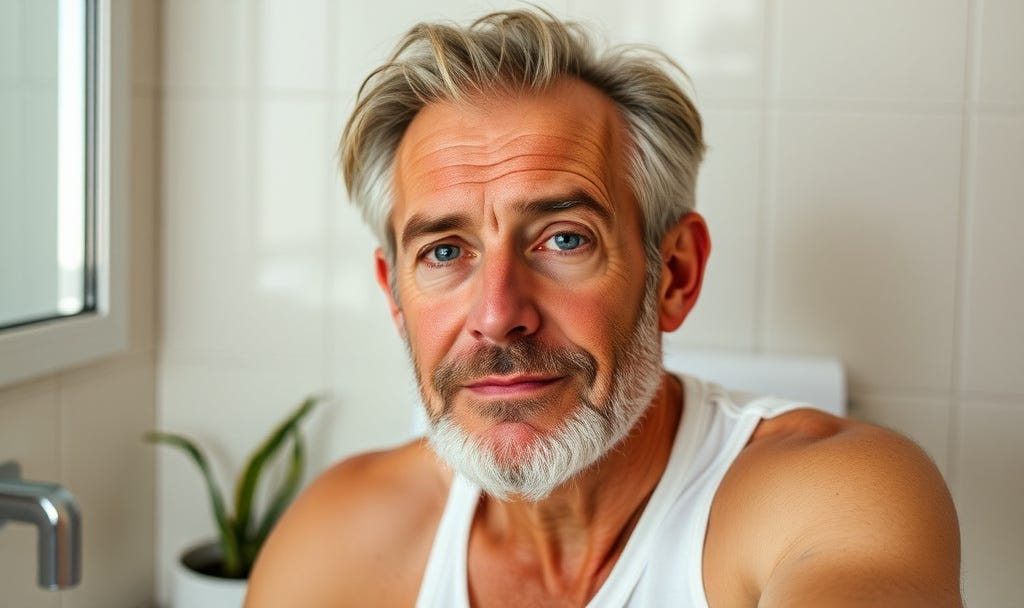
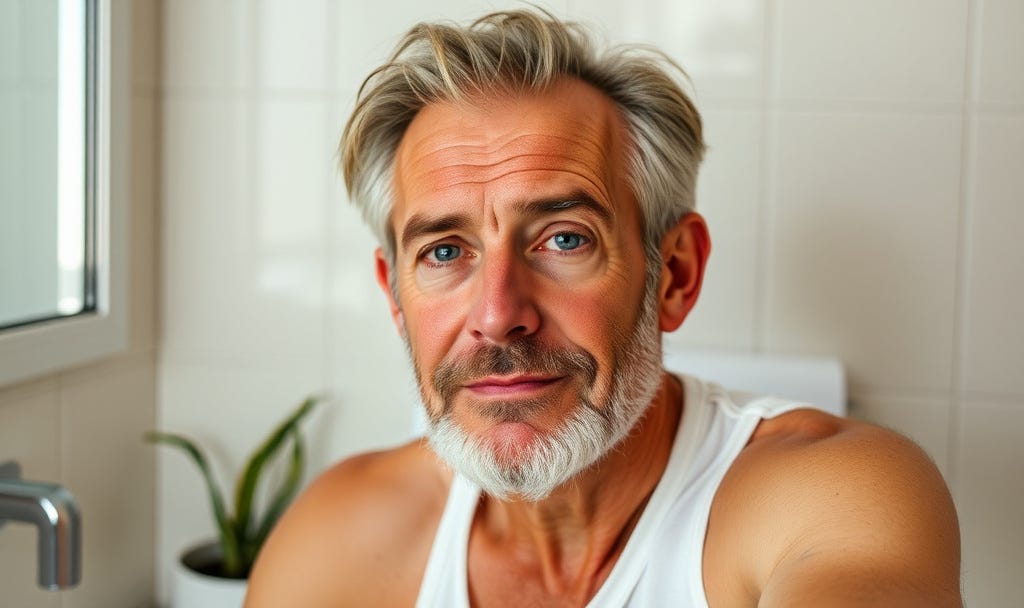
Somewhere in my fifties, I took on a second job.
Not paid.
Not in any contract I’d ever signed.
The unpaid role of Looking As Young As Possible.
It didn’t arrive like a storm.
It crept in like fog.
I started:
-
standing a bit further back in photos
-
tilting my chin as if I was lining up a bearing
-
avoiding harsh lighting the way we used to avoid unlit reefs
I’d catch my reflection in a shop window and mutter, half‑joking, “Who’s that old bloke?” while secretly wanting to step off the edge of the chart altogether.
I told myself it was normal.
Everyone my age groaned about their neck.
Everyone wanted to “knock a few years off” their face.
The message was clear enough: ageing was acceptable, but looking like you were ageing was some kind of failure of seamanship.
Then one day I caught sight of myself and realised I wasn’t really trying to look younger.
I was trying to look less like myself.
And that, more than any storm I ever sailed through, was exhausting.
Free Subscriber ? You can also read on Medium
The performance of agelessness
We live in a world that treats “ageless” like a compliment.
-
“You don’t look your age.”
-
“You could pass for fifty.”
-
“What’s your secret?”
On the surface, it sounds kind.
Underneath, there’s a quiet sting:
“Looking your age is bad.”
Once you swallow that, you end up running your life like a cheap refit.
You:
-
angle your phone just so on video calls, hunting for the one forgiving angle
-
learn which loos and shop mirrors are kindest
-
buy creams that promise miracles in six weeks if you apply them twice a day and suspend disbelief
None of this makes you vain or shallow.
It just keeps you slightly at war with your own face.
And there comes a point – it did for me – where the war ages you faster than the wrinkles ever did.
The day the camera turned round
My moment of truth didn’t come in a clinic.
It came in the living room, courtesy of a small grandchild and a big tablet.
We were taking silly photos.
They flipped the camera to selfie mode and launched themselves at me.
Suddenly there we were on the screen:
My weathered, tide‑marked face next to their bright, unbothered one.
I did what middle‑aged men are trained to do.
I pulled a daft face.
I said, “Blimey, look at that old sea‑dog. Delete that one.”
They looked at me, genuinely puzzled.
“But that’s just your face. I like your face.”
It landed harder than any gale warning.
Two things hit me at once:
-
I’d been bad‑mouthing a face that had kept me afloat for over sixty years.
-
If I kept doing it out loud, this child would learn to speak to their own face the same way.
Right there, on that sofa, with biscuit crumbs on my jumper and a tablet in my lap, I decided I was done trying to look younger.
Not because I’d achieved some mystical level of self‑love.
Because I refused to spend the rest of my life insulting the only face that had steered me through every port, storm and homecoming.
Honesty as a different kind of beauty
These days, I’m not aiming for “youthful”.
I’m aiming for honest.
Honest looks like:
-
wearing clothes that suit the hull I’ve got now, not the ship I captained at forty
-
letting my hair go the colour it wants, without pretending it’s some curated “silver look”
-
choosing skincare that feels good on my skin, not because some glossy ad promises to “reverse” anything
Honesty also sounds like saying, out loud:
-
“Yes, that’s me in that photo. That’s how I look.”
-
“Yes, my neck is doing that thing. It’s held my head up since 19‑something. It’s earned the right.”
It doesn’t mean I never flinch.
Some days I catch myself in a window and feel that jolt of, Who’s that older man? Oh. It’s me.
I’m just learning not to heap shame on top of surprise.
The lines are information.
Not a crime.
What I’ve gained by dropping the act
Stopping the “look younger” project hasn’t turned me into a saint.
But it has given me three precious things.
1. My energy back.
I no longer sail off into late‑night rabbit holes promising miracle fixes.
That time now belongs to books, conversations, and the sleep I never got enough of at sea.
2. Less self‑consciousness.
When you stop trying to disguise your age, you stop plotting your life around other people’s lenses.
I’ll still stand near a window for a kinder Zoom call.
I just don’t pretend the man in the frame is someone else.
3. Better conversations.
When you stop pretending, other people relax.
Old shipmates admit they’re done with the chase.
Younger folk ask real questions about what getting older actually feels like.
Men my age quietly confess they’re shattered from trying to look “strong” when their knees gave up years ago.
Honesty doesn’t make you invisible.
It makes you reliable.
But what about “letting yourself go”?
This is the fear, isn’t it?
That if we stop trying to look younger, we’ll slide into the cartoon version of old age:
-
food on jumper
-
no self‑respect
-
giving up entirely
That’s not what I’m talking about.
There’s a world of difference between neglect and acceptance.
Neglect says, “Nothing matters any more.”
Acceptance says, “Different things matter now.”
I still:
-
brush what’s left of my hair
-
splash on aftershave when I fancy it
-
pick clothes that make me feel like myself, not a walking apology
I just don’t do those things in the hope of erasing decades.
I do them as an act of respect for the man who lived them.
A small experiment in being seen
If you’re tired of the looking‑younger job but afraid to hand in your notice, try this.
For one week:
-
Notice how often you insult your own appearance out loud.
“I look awful.”
“Don’t take one from that side.”
“God, look at my…”
-
Each time, pause.
Ask: “Would I say this to a mate’s face? To my daughter’s? To my younger self?”
-
Replace it with something neutral or kind.
“That’s just my face.”
“Yes, I’ve earned those lines.”
“I look like someone who’s lived.”
You don’t have to believe it yet.
You’re simply refusing to be your own bully.
Because here’s the quiet truth I keep circling back to:
Ageing isn’t the enemy. Pretending you’re not ageing is.
Pretence steals presence.
It drags you away from the moment you’re actually in and strands you in an endless before‑and‑after comparison.
Honesty lets you turn up fully as the age you are.
To:
-
feel a small hand slip into yours and remember the day you held their parent’s for the first time
-
laugh with old friends without worrying what your face is doing while it happens
-
meet your own gaze in the mirror and think, if not “handsome”, then at least, “There you are. I know you.”
I don’t want to spend whatever time I’ve got left squinting at my reflection, trying to sail backwards into some earlier version of me.
I’d rather steer the years ahead with the same clear eyes I now bring to the years astern.
That doesn’t make every wrinkle a delight.
It just makes them true.
And at this stage of the voyage, truth is more flattering than any filter I’ve tried.
⬇️ A gentle invitation
Before you continue, a gentle note: paid subscribers get access to all of my private guides, behind-the-scenes AI methods, and step-by-step ways to turn your knowledge into income in a calm, grounded, sustainable way.
They’re designed for people who’ve spent years accumulating wisdom and want to turn that experience into something meaningful, useful, or quietly profitable — without the noise, pressure, or hustle the rest of the internet pushes.
You might find something in there that opens a door you didn’t realise was locked.
If subscribing isn’t right for you at the moment, you can always support my work by buying me a pot of tea.
I appreciate every kindness — truly.