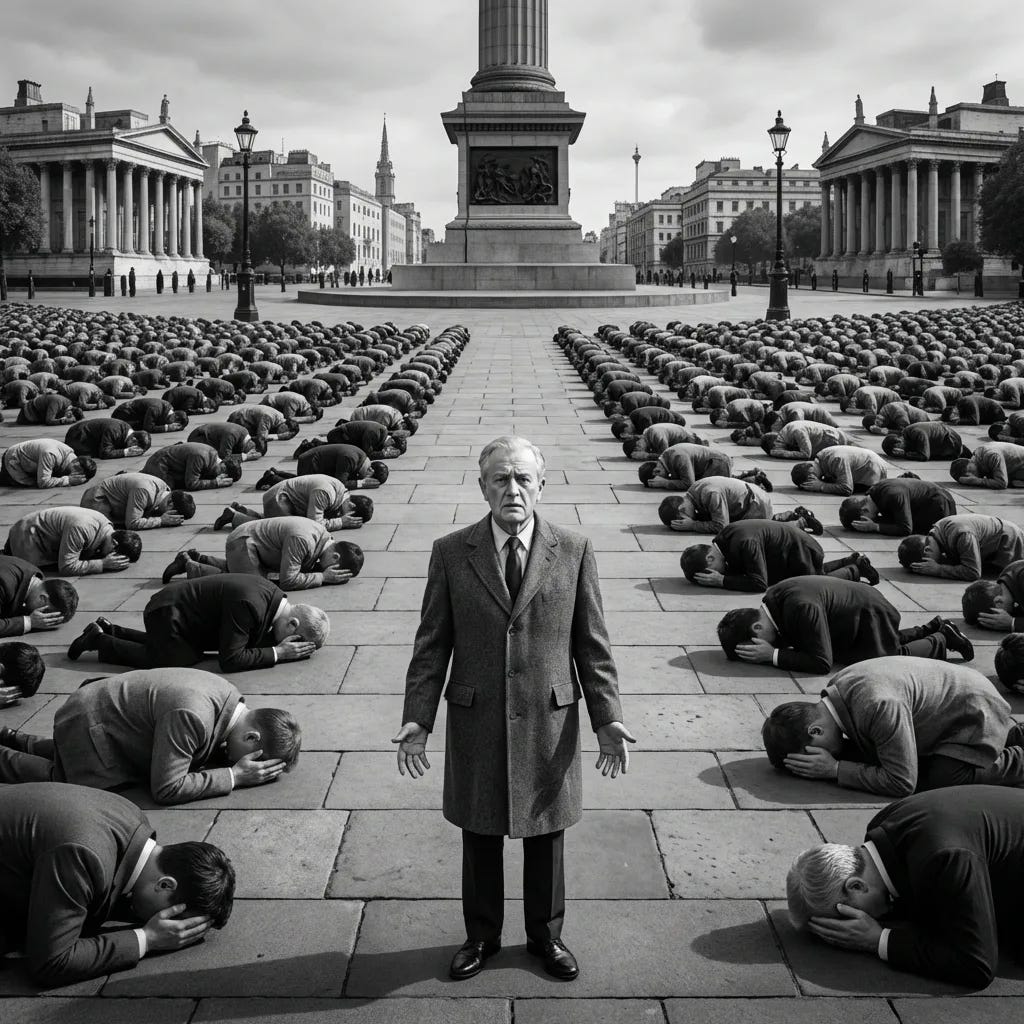
There’s a man in Trafalgar Square.
He’s not sightseeing.
He’s not feeding the pigeons.
He’s praying — loudly, publicly, with several hundred others, blocking the road and making absolutely certain you notice.
There’s a mosque ten minutes away.
He knows that.
You know that.
The square is the point.
I watched this on the news and felt something I’m apparently no longer supposed to feel: irritation. Plain, ordinary, non-criminal irritation. The kind my father’s generation would have called common sense.
Instead I did the calculation my generation has quietly learned to do. Can I say this out loud? Is noticing this permitted? Have I become, without being informed, one of the people whose opinions require a content warning?
I grew up in a country where you could doubt God without it being a social offence. We used to call that civilisation.
Let me be precise — because precision matters now in a way it didn’t used to, and I want to stay on the right side of whatever line someone has drawn while I wasn’t watching.
I don’t object to anyone’s faith.
Believe whatever keeps you functional.
I genuinely don’t care what you do in your mosque, your church, your kitchen.
What I object to is paying for someone else’s certainty.
Literally paying.
My fuel bill has gone up.
My shopping costs more.
The roads near me get blocked by people who are furious about a war being fought by other people in another country, on behalf of a version of God I was never asked to endorse, over territory I couldn’t locate without a map and a patient friend.
I have no vote in this.
No say.
No standing.
And apparently, now, no opinion — or at least no opinion I’m permitted to express without someone suggesting my character needs examining.
Here’s what nobody seems to want to talk about.
The concept of heresy — actual heresy, the idea that questioning someone’s religion is an offence against public order — has quietly returned.
It didn’t announce itself.
It didn’t arrive with a debate or a referendum or even a mildly awkward conversation.
It just appeared one day in the legal grey area between hate speech legislation and social media pile-ons, and now it sits there, unelected and permanent, reshaping what a 67-year-old secular Englishman is allowed to say in his own country about his own life.
I didn’t vote for that either.
The prices went up the same way. Fuel, food, energy — all of it grinding steadily upward because of conflicts I can’t influence, fought by people nobody elected, about territory that has been argued over since before my grandparents were born. I’m not destitute.
I’m not collapsing under the weight of it.
But I notice the till receipt now in a way I didn’t five years ago, and I’m old enough to remember when that kind of noticing was just called paying attention, rather than a symptom of something that needed correcting.
Here’s the part that keeps me awake.
My generation didn’t inherit free expression.
We were handed the argument for it — centuries of people who paid dearly for the right to doubt, to question, to say the unsayable about powerful institutions without disappearing into a cell or a mob.
We understood what it cost.
We thought we were the custodians of something hard-won and permanent. We genuinely believed the age of being punished for your opinions was behind us.
What we didn’t account for was how quietly it could be taken back.
Not with jackboots.
Not with a dramatic announcement.
Just with a gradual, politely worded redefinition of what constitutes harm, applied selectively, enforced socially, until one morning you’re doing a calculation in your own kitchen about whether your irritation is legally permissible.
That’s not civilisation advancing.
That’s civilisation reversing, in comfortable shoes, with a strongly worded letter.
I think about the people who actually fought for this country’s right to be secular.
Not metaphorically fought — actually fought, in uniform, in conditions I understand better than most having spent decades at sea in weather that would rearrange your priorities.
They didn’t do it so that sixty years later a man could block Trafalgar Square to make a political point about a foreign war while the rest of us stood on the pavement calculating whether we were allowed to find it odd.
They did it so that we could all believe whatever we liked, quietly, without imposing the bill on someone else.
That bargain seems to have been quietly renegotiated while I was getting on with things.
What makes me angriest — and I’m using that word deliberately, because I’ve decided I’m allowed it — is that nobody asked.
Not once, at any stage of this process, did anyone think it worth consulting the people who were already here.
Already paying.
Already living quietly secular lives in a country that spent several centuries arguing its way toward the principle that you shouldn’t be punished for your doubts.
My generation was told that free expression was a hard-won thing.
We believed it.
We thought the argument was settled.
Turns out it wasn’t settled.
It was just resting.
The man in Trafalgar Square prays on.
The fuel bills arrive.
The legislation edges forward.
And somewhere in a committee room I’ll never see, people who’ve never met me are deciding what I’m permitted to think about all of it.
My tea has gone cold.
I find, at 67, that I mind about that more than I probably should.
It’s the one thing in this entire situation still entirely within my jurisdiction.