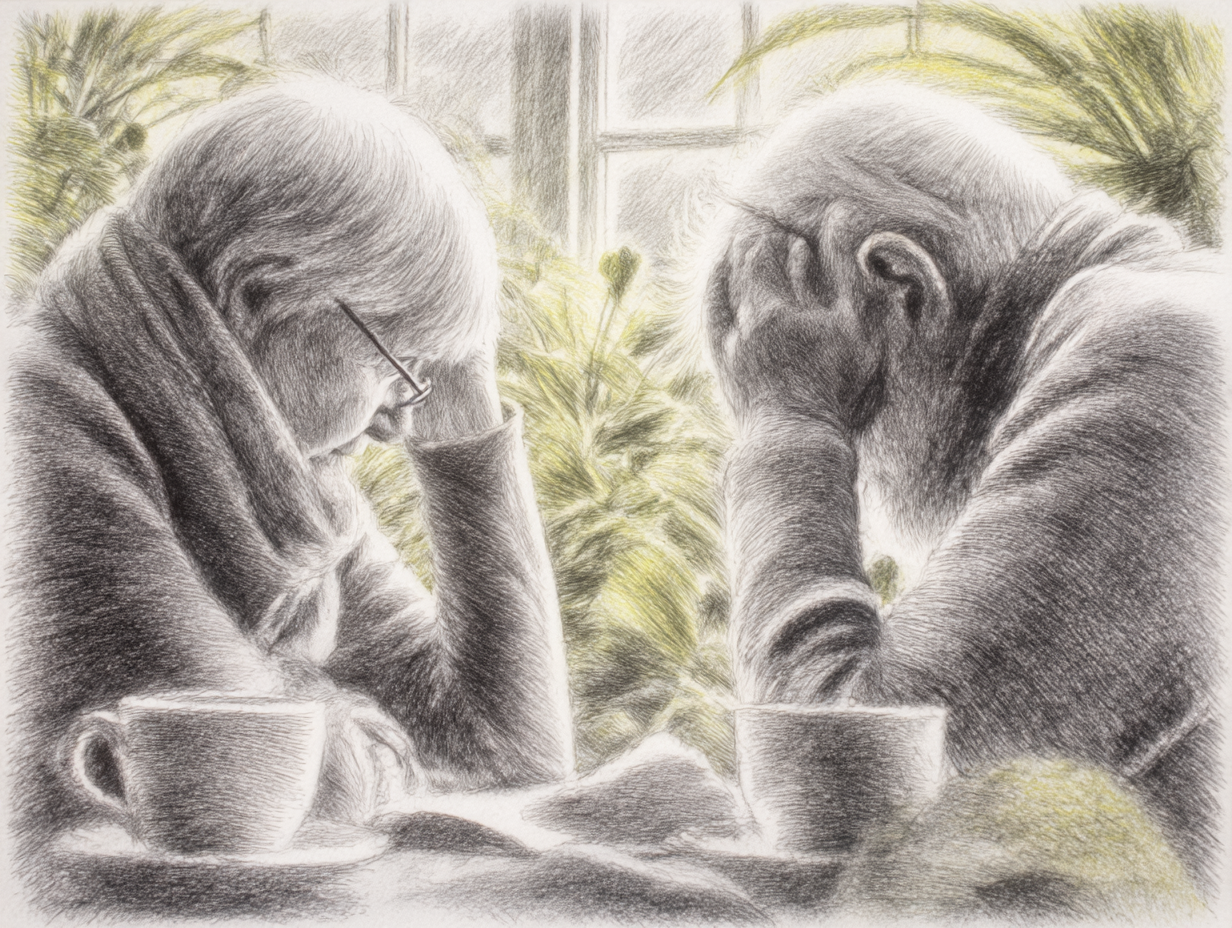
You can live under the same roof for decades and still be strangers.
Yesterday, I watched Margaret and Colin at our local garden centre café. Married 46 years. They sat across from each other, not speaking a word for thirty-seven minutes. I timed it. When Colin’s fork clinked against his empty plate, Margaret looked up, startled, as if she’d forgotten he was there.
They aren’t unhappy, exactly. Just… disconnected. Like flatmates who’ve run out of things to say but can’t afford to move out.
Our generation doesn’t talk about this particular loneliness. The one that happens when you’ve achieved everything the marriage manual promised: the house, the children, the retirement. Then you look across the breakfast table and wonder who this other person is, now that the scaffolding of careers and childcare has been dismantled.
It feels ungrateful to admit you’re lonely with someone sitting right there. After all, isn’t this what we worked for? To finally have peace and quiet together? But what happens when “together” becomes a geographical description rather than an emotional one?
If this struck a chord, the deeper part of the story carries on below for paid readers.
Before you continue, a gentle note: paid subscribers get access to all of my private guides, behind-the-scenes AI methods, and step-by-step ways to turn your knowledge into income in a calm, grounded, sustainable way.
If subscribing isn’t right for you at the moment, you can always support my work by buying me a pot of tea.
I appreciate every kindness — truly.
⬇️ Keep reading for the deeper story — and the moment that forced me to change everything.
The content below was originally paywalled.
I should confess that watching Margaret and Colin unsettled me because I recognised something of my own marriage in their silence. Last Tuesday, Jean and I realised we’d gone an entire evening without speaking beyond “Is there any more tea?” and “Did you lock the back door?”
We weren’t angry. We weren’t even unhappy. We were just… conserving energy. Like old mobile phones that need to be charged more frequently, we’ve started rationing our emotional expenditure. But at what cost?
Psychologists have a term for this: emotional retirement. It’s when couples stop investing in their connection because the infrastructure of their shared life – the children, the jobs, the social obligations – no longer demands it. The relationship doesn’t end; it simply thins out.
The data suggests we’re not alone. A 2023 survey from Age UK found that 24% of couples over 65 reported feeling “emotionally distant” from their partner, despite living together. More telling was that 68% considered this normal and expected.
The peculiar grief of growing old together
What nobody prepared us for was how retirement would strip away our identities one by one, leaving us raw and unfamiliar, even to ourselves.
Jean was a primary school headteacher for thirty years. I watched her gradually dismantle her professional self when she retired – first the confident voice, then the decision-making muscles, finally the habit of being listened to. I didn’t fully recognise the quieter woman who emerged, and I suspect she didn’t either.
Meanwhile, I lost my own anchors – the publishing company I’d built, the colleagues who respected my opinion, the daily rhythm of purpose. Without these external validations, I became prickly, defensive, boring. I knew I was being boring, which made me even more boring.
We were like two people who’d shown up for different parties, standing awkwardly in the same room.
The most painful moment came last autumn, when our daughter asked us what we do all day. “We watch the birds,” Jean answered, with a nervous laugh. It wasn’t untrue. But the flat simplicity of it – the absence of anything more substantial to report – caught in my throat like a fishbone.
The crowded emptiness
The cruel paradox is that retirement gives us more time together than ever before, but less to talk about.
Without the daily friction of separate lives rubbing against each other – “You’ll never guess what happened at work” or “The school called about Tom again” – we’re left with the weather, digestive complaints, and whatever’s on telly. The space between us isn’t filled with silence so much as with low-stakes chatter that neither nourishes nor challenges.
This isn’t just a matter of boredom; it’s a spiritual crisis. To be known is a fundamental human need. To be unknown by the person who sleeps beside you is a particular kind of homesickness – you’re right where you’re supposed to be, but you don’t belong there.
I found myself, at 67, longing to be seen again. Not just acknowledged or tolerated, but properly seen – with curiosity, with attention, with the kind of loving scrutiny that makes you feel substantial in the world.
What now? Small steps back toward each other
Jean and I aren’t fixing this overnight. But we have started with some deliberate practices that are slowly rebuilding the muscle of attention:
The three-question rule: At dinner, we each have to ask the other three genuine questions – not about logistics or schedules, but about thoughts, feelings, or memories.
Separate adventures: We’ve committed to doing one thing each week without the other, purely so we have something new to share.
The gratitude practice: Before sleep, we each name one thing we appreciated about the other that day – even if it’s small. This forces us to actually notice each other.
Technology-free zones: The living room after 7 pm is now a phone-free, tablet-free space. We’ve rediscovered board games, and the silly competitiveness has been unexpectedly intimate.
Physical touch without expectation: A hand on a shoulder, sitting close enough on the sofa that our legs touch. Not as prelude to anything, just as contact for its own sake.
The most important change, though, has been giving ourselves permission to admit the emptiness. To say, without blame, “I miss feeling close to you” – and to hear the relief in the other’s voice when they say, “Me too.”
The courage to be a beginner again
Last month, Jean and I signed up for a pottery class. Neither of us has any natural talent for it. My first attempt at a bowl looked like it had been made by a drunk child with mittens on. Jean’s wasn’t much better.
We laughed until we cried, clay-splattered and humble. Walking home, our hands found each other without thinking, and I realised we were experiencing the same moment from the same emotional angle for the first time in years.
That’s the thing about these late-life partnerships. Sometimes you have to deliberately make yourselves beginners again – clumsy, vulnerable, and mutually dependent – to remember why you chose each other in the first place.
The real work of retirement isn’t financial planning or health maintenance. It’s learning to see each other anew when all the roles that defined you have fallen away. It’s the courage to ask, with genuine curiosity, “Who are you now?” and to listen, with genuine interest, to the answer.
A gentle invitation
If this resonated with you, you may enjoy exploring my private guides and AI-supported methods here:
They’re designed for people who’ve spent years accumulating wisdom and want to turn that experience into something meaningful, useful, or quietly profitable — without the noise, pressure, or hustle the rest of the internet pushes.
You might find something in there that opens a door you didn’t realise was locked.
For those who want to go deeper, I’ve created extended guides and resources at my Gumroad page — practical tools for thinking and creating in our fast-paced world.