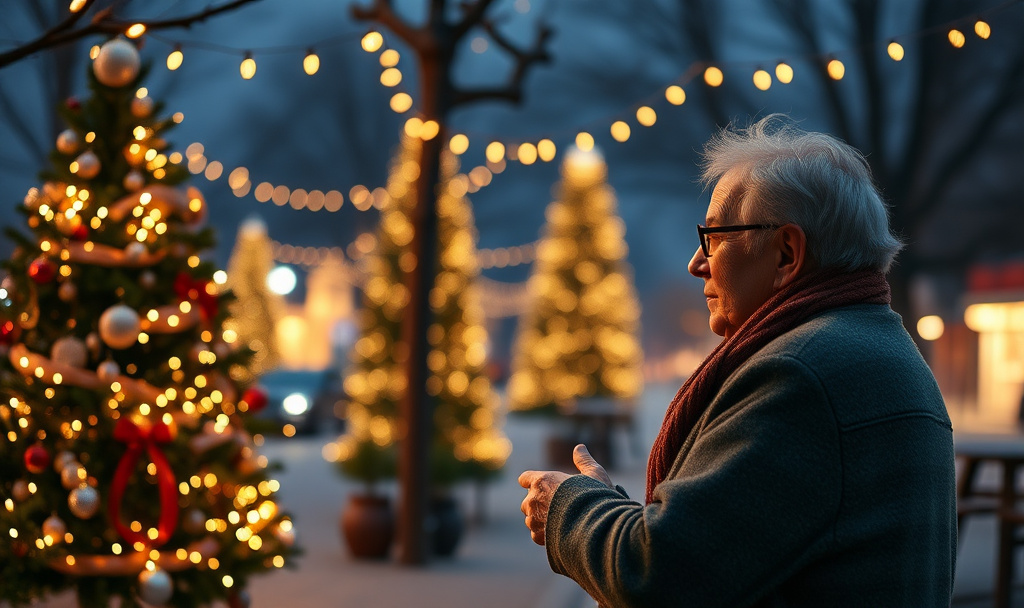
The short days of December carry weight that youth never warned us about. What was once a month of anticipation becomes, past sixty, a season of accounting—both with the year and with ourselves.
I sit at my kitchen window watching the winter light fade by four. Steam rises from my mug, fogging the glass that separates me from the early evening darkness. Outside, a neighbour struggles with shopping bags, his breath visible in the streetlight. Inside, the radiator clicks as it expands, marking time in its own mechanical way.
We’re the generation that grew up with Christmas specials on three channels and selection boxes that felt like treasure. December was Morecambe and Wise, the Radio Times double issue, and the promise of snow that rarely materialised south of Yorkshire. The build-up mattered more than the day itself. Anticipation was the real gift.
Now December arrives with its own gravity. The calendar pages turn faster each year, yet December stretches like a long corridor we must walk through to reach another January. For those of us past sixty, it’s not just the season that weighs—it’s the accumulated Decembers we carry with us.
There’s an unspoken expectation that we’ll manufacture joy for others while quietly managing our own inventory of losses. Partners no longer at the table. Friends who’ve moved away or moved on. Parents long gone whose voices still narrate our Christmas memories. The empty chairs multiply as the years stack up.
I never understood my father’s retreat to his shed each December until I found myself doing the equivalent—taking longer walks alone, lingering in bookshops, or sitting in the car after shopping trips, reluctant to bring my purchases indoors and face the ritual of wrapping them.
Research suggests seasonal affective disorder hits harder in older adults. It’s not just the lack of light but the heightened contrast between social expectations and internal experience.
A study from Age UK found 1.4 million older people find Christmas a particularly difficult time.
We’re not broken—we’re responding naturally to the dissonance between commercial cheer and lived experience.
The weight of December past sixty isn’t simply about nostalgia or loss. It’s about perspective—the kind that only accumulates with decades. We’ve seen enough Decembers to recognise patterns, to feel the rhythm of what rises and falls with the turning year. The season asks more difficult questions now: What remains undone? What matters in the time left? Who am I when the roles that defined me—parent, worker, partner—shift or disappear?
I stood in Tesco last week, frozen before the Christmas card display. A young mother nudged past with her trolley, efficiently selecting cards for teachers and relatives. I envied her certainty, her untroubled relationship with the task. My hand hovered over cards for people I’m no longer sure need hearing from me. The list shrinks each year—not just through deaths but through the natural attrition of relationships that once seemed essential.
The weight feels physical sometimes. December bones ache differently. The cold finds the weak spots—the knee that never properly healed, the shoulder that predicts rain. The body becomes a weather vane, sensing changes before they arrive. And in December, everything changes—the light, the temperature, the social calendar, the expectations.
Yet there’s something quietly profound in this heaviness. It’s not depression exactly, though it can slide into that territory if we’re not careful. It’s more like a deepening—as if December past sixty gives us permission to feel the full weight of our years, to acknowledge what we’ve gathered and what we’ve lost.
I’ve learned to navigate December differently now. I treat it like a sea passage through potentially rough waters—preparation matters, course corrections are expected, and there’s no shame in battening down hatches when needed.
Some practical adjustments help. I schedule solitude deliberately rather than feeling guilty about needing it. I’ve abandoned late-night gatherings in favour of breakfast meet-ups when my energy is fresher. I’ve made peace with saying no to events that will deplete rather than nourish me. These aren’t selfish choices but survival tactics in a season that demands more than many of us can give.
The surprising grace of December’s heaviness is that it can lead to unexpected lightness. When we stop fighting the weight, when we acknowledge it as a natural consequence of a long-lived life, something shifts. There’s relief in admitting that Christmas past sixty isn’t the same as Christmas at thirty or forty, and it shouldn’t be.
Recently I found myself alone on a Tuesday afternoon, the rain streaming down my windows, a book abandoned beside me. Instead of forcing myself into productivity or festive preparation, I simply sat with the heaviness. I let December be December—short-dayed, rain-soaked, memory-laden. And in that surrender came an unexpected spaciousness, room to breathe between what was expected and what was needed.
Perhaps this is December’s gift to those of us in our later decades—permission to experience the season authentically rather than performatively. The heaviness creates its own gravitational pull toward what matters. It strips away pretence. It demands honesty.
The Christmas cards I eventually bought remain on my desk, unsent. Instead, I’ve started writing letters—real ones, with paper and stamps—to the handful of people who’ve travelled the longest distances with me. Not holiday greetings but life greetings, acknowledging the weight and worth of our shared decades.
December feels heavier when you’re over sixty because we’re finally strong enough to carry it properly. We’ve earned the right to feel its full significance, to recognise both its darkness and its strange, quiet gifts. The heaviness isn’t something to overcome but something to inhabit, to explore like a familiar yet always changing landscape.
The year winds down.
Light returns by increments after the solstice.
We carry our Decembers with us into another January, another spring, another turning of the wheel.
The weight becomes part of who we are—not a burden but a ballast, keeping us stabilised regarding what matters as we navigate whatever seas remain ahead.
⬇️ A gentle invitation
Before you continue, a gentle note: paid subscribers get access to all of my private guides, behind-the-scenes AI methods, and step-by-step ways to turn your knowledge into income in a calm, grounded, sustainable way.
They’re designed for people who’ve spent years accumulating wisdom and want to turn that experience into something meaningful, useful, or quietly profitable — without the noise, pressure, or hustle the rest of the internet pushes.
You might find something in there that opens a door you didn’t realise was locked.
If subscribing isn’t right for you at the moment, you can always support my work by buying me a pot of tea.
I appreciate every kindness — truly.
Beautiful; true.
I remember letters. I spent my teenage years pouring my heart out onto blank pages and waiting with my heart
hanging outside my body for the return letter to arrive and make me whole again. The last time I wrote a letter? Decades?
Well you’re obviously making lots of retirement £ from this to be able to afford a postage stamp! £1.70 ffs! 😂. Actually I’ve found that I thought didn’t know what SAD was until perhaps the last 10-15 years or so. There is a weight of it. Mines January tho. December I don’t have time for it… wife has got me doing too much to allow it in 😂
= Hand delivery.
Thank you for this. You have an uncanny gift for articulating what I’m feeling. And i couldn’t agree more about the value of a hand written letter
I remember hitting the old Basildon Bond and line guide every year to say thanks to Grandparents who had sent me gifts when I was younger. My mum used to badger me to write them and I always thought it was a waste of time. When they died, I discovered that they had kept my letters in a box with a bow on top. I then realised how much it meant to them to receive a handwritten letter from me. We’re losing the old traditions and it doesn’t feel like progress to be honest.
I enjoyed reading your article as it prodded me into appreciating the way my parents see things. I expect when I turn 60 things will be a lot different than they are now, but hopefully in a good way.
You have just articulated my feelings as I sit with my coffee at 7.44 AM, December 22nd.
Thank you.
Absolutely perfect – as I sit with my coffee thinking of my mom on what would be her 97th birthday. Thank you.
A honest description of something not often acknowledged or talked about. Refreshing ~ Rosie
This is so true. This has become a harder time to get through as an older adult.
Thank you for the gift of these beautiful thoughts today.
Thank you for articulating what I have been struggling to define.
I have a few decades before my 60’s but your words still resonate. 2025 has bashed me into surrender. Not defeat, but a quiet acceptance of what is and a letting go of any remaining attachments to how my life should look like. There’s both a sense of loss and liberation.
I’m well over 60, and I wish I had time for that reflection. I feel busier now than when I was working full time. Caregiving, working part time, family members’ circumstances all sap my time and energy. But I do feel some of what you’re feeling and the short days seem so much shorter and darker now. But then the whole world seems darker. That’s why I look so forward to the celebration of Christmas and the birth of the One who is the light of the world.
Really enjoy the heart of your writing
As I live my last year in the 60’s and looking forward to the 70’s- I can relate to much of the lovely prose you shared today.
Yes. All of this.
This is profound, and true.
“The ability to let December be December” was a strangely comforting phrase, as the rain pours down and I wonder why Christmas this year feels less festive than 50 years ago. Thank you.
This is beautifully reflective and deeply resonant. I love how you capture the nuanced weight of December past sixty, the blend of memory, loss, and quiet grace. The way you honor both heaviness and lightness makes the piece feel profoundly human and tender.
I live alone now (with my dog) and although I miss the excitement and chaos of days past, when I had a young family, I find myself seeking the solitude that can be difficult to find during the holidays. Although I had invitations for Christmas Eve and Christmas dinner, I declined. I don’t need to be with people because it’s Christmas. This year, I’m choosing quiet reflection.