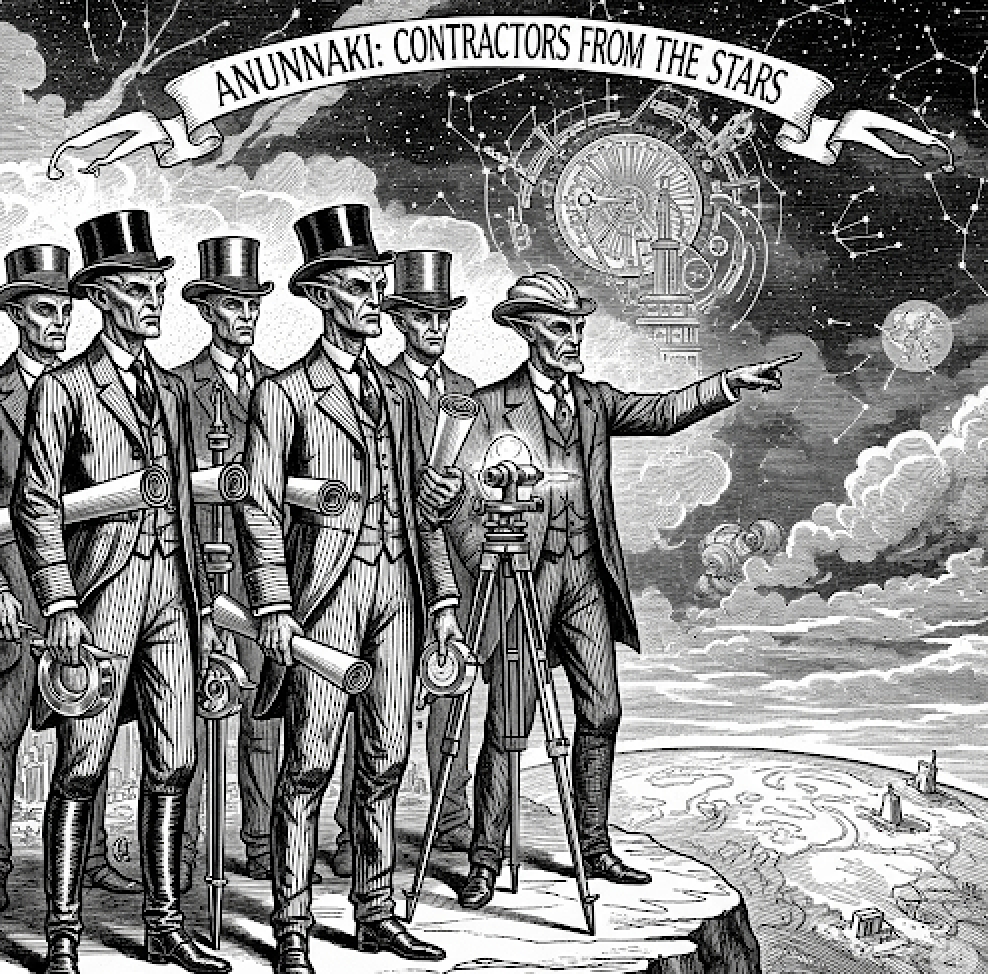
The Anunnaki theory you’re not supposed to enjoy this much.
⚡️ If ancient mysteries, sky-gods with toolbelts, and history’s awkward questions are your cup of tea, hit “Follow,” clap the life out of this piece, and drop your spiciest what-if in the comments. Let’s poke the past with a stick—together.
Imagine the past with the safety catch off. Dust-caked tablets, stones that refuse to behave, and a whisper that maybe—just maybe—the gods weren’t gods at all but visitors with excellent toolkits and a terrible attitude to customer support. That’s the Anunnaki idea in a nutshell: not angels, not myths, but someone’s neighbours from a very long way away who popped round, taught us a few party tricks, and vanished before the washing up.
Here’s why the thought won’t die—and why the grown-ups at the back keep rolling their eyes.
The Case for “They Were Here”
Start with the oldest stories. The Sumerians didn’t write limericks; they wrote operating manuals for civilisation, sprinkled with beings called the Anunnaki who behave less like fluffy deities and more like management. King lists with rulers living for centuries. Epics where “gods” stride in, set the rota, and leave cryptic notes in cuneiform. If you squint, it reads less like mythology and more like minutes from a meeting that ran late.
Then there are the monuments. Pyramids aligned as if the architects had laser levels and a weekend to spare. Stones at places like Stonehenge stacked with the sort of insouciant precision you only get when gravity is a suggestion. Ancient “batteries,” suspiciously clever metallurgy, drill marks where chisels shouldn’t reach—hints, perhaps, that somebody brought the teacher’s edition while the rest of us were still chewing the crayons.
And the chorus of echoes. From Mesopotamia to Mesoamerica, you find the same plot: shining ones descending from the sky, handing out knowledge, occasionally losing patience and flooding the place. Different costumes, same script. Either humanity collectively binge-watched the same cosmic drama—or it happened, and everyone’s describing the tour bus from their seat.
The Case for “Calm Down, Mate”
Now the skeptics, clutching the clipboard. First: no smoking ray gun. No landing gear in a museum, no molten-glass runway with PROPERTY OF ANUNNAKI stamped on it. What we have is interpretation—clever, tantalising, but interpretation all the same. You can read a myth as memory… or metaphor. Depends how caffeinated you are.
Second: ancient texts are tricky. They speak in symbols, not spreadsheets. A god who “descends” might be a storm, a king, or a bloke with a very shiny hat. Turn every serpent into a spaceship and you’ll soon be arguing your toaster is an oracle.
Third: if the Anunnaki ran Earth’s first apprenticeship scheme, where’s the aftercare? No postcard, no “back in 3, keep irrigating.” Legends mutter about departures, but they don’t give you a return date. If this was a long-term project, it’s customer support on par with certain mobile networks—signal when you don’t need it, silence when you do.
The Delicious Middle
So which is it—cosmic foremen or poetic flourishes? Here’s the bit that makes me grin: you don’t need to choose to be curious. Our ancestors weren’t idiots. They watched the sky like hawks, built with gusto, and told stories to make sense of the impossible. If something extraordinary did happen—visitors, lost tech, a civilisation we’ve forgotten—where would the fingerprints be? Exactly where we find them: in myths that read like minutes and in stones that misbehave.
And if nothing otherworldly happened? The mystery is still glorious. Humans, with no instruction manual, lugged stones the size of lorries across bogs and deserts, mapped the heavens with naked eyes, and encoded their wonder in clay. That alone should keep you awake at night.
What If…
What if the king lists are garbled memories of lifespans extended by knowledge we mislaid? What if “gods from the sky” is the best language a Bronze Age poet had for people stepping out of machines? What if a shard of something unambiguous—an alloy we can’t reproduce, a blueprint that actually works—lies three trowel-scrapes below the site we closed last summer?
Here’s my wager: keep the mind open and the standards high. Don’t worship the mystery; interrogate it. Demand evidence—but don’t pretend curiosity is a character flaw. Because history, like a mischief-loving mechanic, hides spares in places you’d never look.
And if one day a museum intern wipes the dust off a tablet and finds the equivalent of a boarding pass—gate number, departure star, cheeky farewell—don’t say you weren’t warned. Until then, look up, read closely, and keep a suitcase packed. Just in case the neighbours decide to drop by and ask what we’ve done with the place.
If this was useful, there’s more like it on my Substack, The Old Grey Thinker — join here: https://substack.com/@theoldgreythinker