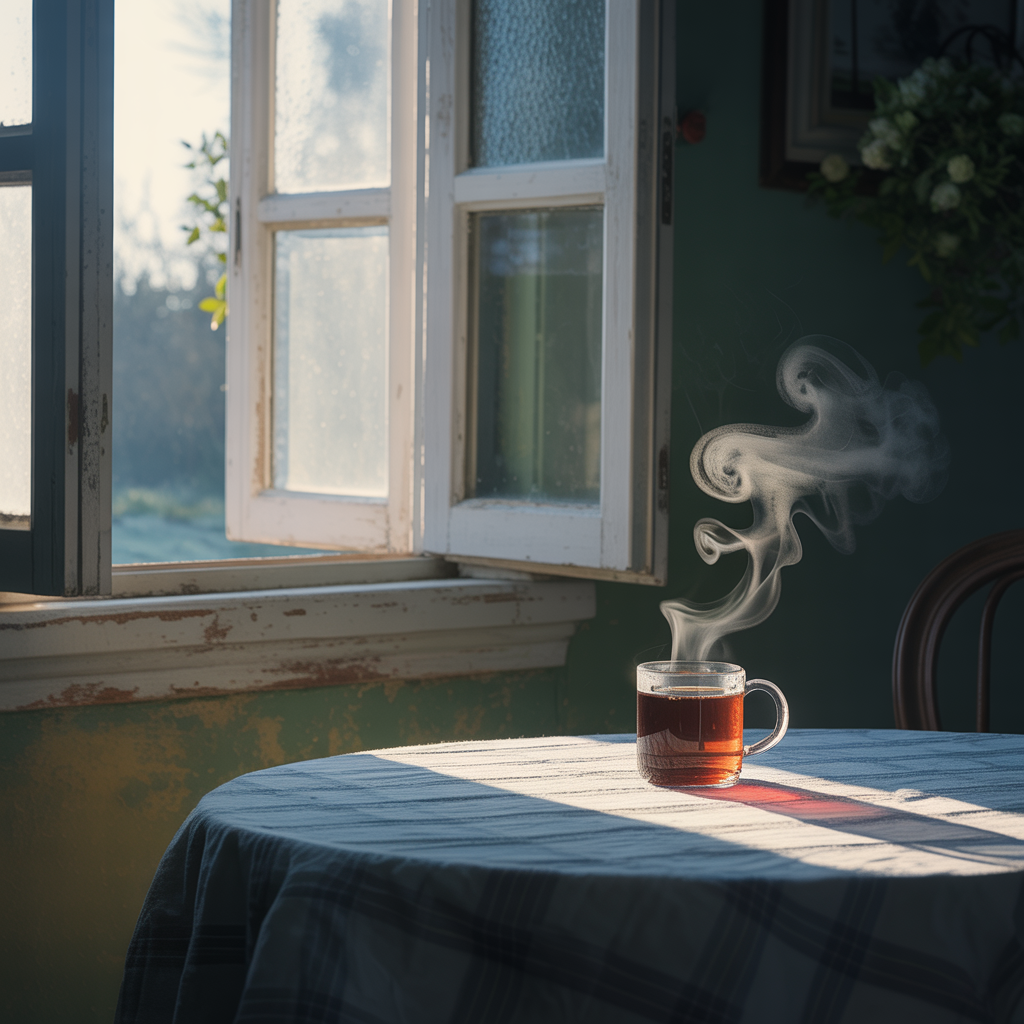
The early hours, when the world still has the decency to hold its tongue, used to be reliable sanctuaries. This morning, I found myself awake at half-past four, padding downstairs in search of that pre-dawn quiet that has become strangely precious.
And yet—the silence wasn’t quite there.
The refrigerator hummed its monotonous complaint. A notification silently flashed on my phone, which I’d absentmindedly brought with me. Outside, the distant rhythm of a delivery lorry making its morning rounds.
It occurred to me, cradling a cooling mug of tea, that true silence has become not just rare but endangered. Not because it has vanished entirely, but because it’s being actively taken from us, parcel by parcel, buzz by buzz, headline by headline.
Silence isn’t merely an absence of sound. It’s the presence of possibility, the canvas on which our deeper thoughts might finally show themselves after hours, days, or weeks of patient waiting. And that canvas is being painted over before we’ve had the chance to see what might emerge.
I remember my father, never a philosophical man by profession but philosophical nonetheless, sitting in his garden chair for hours on Sunday afternoons. I once asked him what he was thinking about during these sessions.
“Probably nothing,” he said, with the faintest smile. “And that’s the bloody point.”
Keep reading — and get more
This is where the full monthly Niche Box lives. Subscribe for $5/month (or $50/year) to get:
• Monthly Niche Box (usually worth $20)
• Full archive of essays
• Early access to new pieces
Or go deeper: Pay $80/year, get everything I’ve ever published (Foundation Member) Most readers choose the monthly plan and upgrade later. Start there.
The content below was originally paywalled.
He wasn’t doing nothing, of course. He was allowing himself the space to process the week, to let his thoughts settle like disturbed sediment in a stream. It wasn’t emptiness—it was a different kind of fullness.
Today, we’ve allowed ourselves to be convinced that any unfilled moment is a failure of productivity or pleasure. The idea of sitting—just sitting—seems almost suspicious. What are you plotting? What are you avoiding? Why aren’t you catching up on those podcasts?
Our attention has been thoroughly commodified. Every waking moment has been assigned a potential market value, and silence—beautiful, unproductive silence—offers poor returns on investment.
Consider the spaces where silence once lived:
The morning commute, once a liminal time of staring out windows and letting the mind wander, now filled with podcasts, audiobooks, news briefings—all worthy, but all noise.
The queue at the post office or bank, once a moment for casual observation or woolgathering, now a chance to catch up on messages.
Even the bathroom, that last bastion of enforced idleness, has become a scrolling chamber.
The theft has been so gradual that we’ve hardly noticed what’s been lost. Like the apocryphal frog in slowly heating water, we’ve adjusted to each incremental increase in stimulation until we find ourselves chronically uncomfortable with our own unaccompanied thoughts.
I’m not suggesting we need to become digital ascetics or pretend we live in 1952. But perhaps we might consider treating silence as something valuable enough to protect—not as empty calories to be eliminated from our mental diet, but as essential nutrition.
Last week, I experimented with deliberate silence. Twenty minutes each morning, sitting in my garden chair like Dad, watching the sparrows argue over the feeder. No music, no radio, no podcast, no newspaper. Just the business of noticing.
The first morning was excruciating. My mind bounced between tasks undone, articles unread, calls unmade. By the third day, something shifted. I found myself following a single thought down winding paths I hadn’t explored in years.
By the fifth day, I realised I’d had an idea for a new project that had been trying to surface for months but couldn’t find a gap in the constant parade of input.
The quality of my thinking changed. Not dramatically—I didn’t suddenly solve cold fusion or compose a symphony—but subtly, importantly. Connections formed between ideas that had been kept separate by the constant compartmentalisation of content consumption.
There’s something almost subversive about reclaiming these moments. In a world engineered to monetise every flicker of our attention, choosing silence feels like a small act of rebellion.
Perhaps that’s why my father smiled when he said he was thinking about “nothing.” He knew he was engaged in something both utterly mundane and quietly revolutionary—the simple act of being present with himself.
The irony isn’t lost on me that I’m writing these words for you to read, adding one more voice to the chorus competing for your precious attention. But perhaps we might conspire together in this small revolution: to recognise silence not as emptiness to be filled, but as something full and alive that’s being stolen from us—and worth stealing back.
If you enjoy how I write, consider subscribing so you don’t miss the next piece — it means a lot.
For readers who like to go deeper, I’ve also collected some extended guides and reflections at http://greythinker.gumroad.com- small tools for thinking and creating in an age that moves too fast.