He used to tie his laces without looking. I remember that from childhood: the casual efficiency of hands that could fix a fuse, scrape ice off a windscreen, scoop a sleepy child off a sofa and carry them up to bed — all without putting his tea down for long.
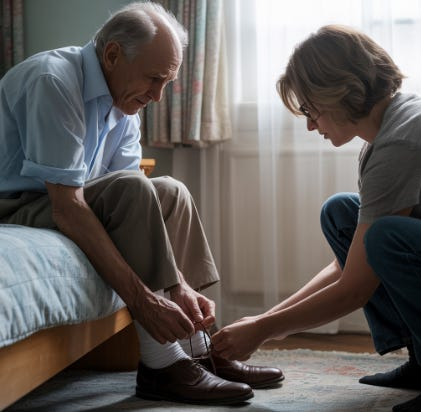
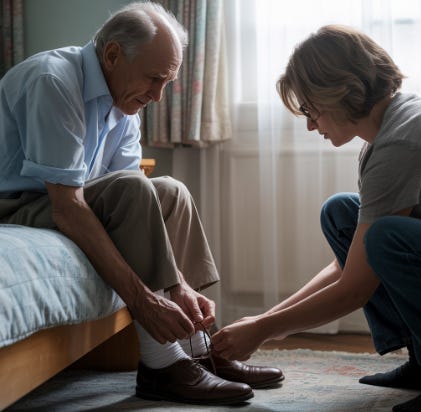
On this particular morning, those hands are hovering over a pair of old leather shoes that have seen better conferences and colder winters. He is sitting on the edge of the bed, breathing a little harder than the effort seems to warrant. The curtains are half-drawn. A stripe of light cuts across his knees, then his fingers, then the laces themselves, spilling limp either side of the shoe like a question he’s not sure how to answer.
I’m in the doorway, pretending to rearrange things on the chest of drawers. You learn, eventually, a kind of choreography when someone you love starts to age. How to be close enough to catch them, but far enough away not to wound their pride. How to watch without staring. How to help without turning them into a project.
He has a go. The movements are there, somewhere in the muscle memory, but not quite in the right order. The lace slips. One end slips from his fingers and dangles. His mouth tightens. He tries again, concentrating now, tongue tucked into the corner of his lips the way it used to be when he was fixing something complicated in the shed.
A loop forms. Then collapses. The lace falls open as if giving up.
He looks at it with a frown that isn’t quite annoyance and isn’t quite confusion. Then he mutters, “Cold hands,” to the room.
We both know it isn’t that.
This is the bit of ageing nobody puts in the brochures. Not the dramatic diagnoses or the hospital drama. The small reversals. The things that once took no thought at all becoming negotiations between memory and fingers. One more tiny piece of competence sliding quietly across the table from their side to yours.
“Let me,” I say, too quickly.
I cross the room and kneel down on the carpet like a child about to be told off. Up close, I can see the scuffs on the leather, the way the stitching is fraying at the toe. I can smell floor dust and old talc, and something that might be the ghost of his aftershave from years when he still bothered to put it on for ordinary days.
It’s my hands that move automatically now. Over, under, pull through. The same over-under I taught my own kids, sitting on the stairs before school, their frustration bubbling over into tears when the rabbit refused to go round the tree in the right direction.
“Sorted,” I say, too brightly, patting his knee as if he’s the child and I’m the reassuring adult. It lands in the air between us like a badly aimed joke.
He shrugs and makes some crack about “getting old, eh?” We both laugh on cue. Then I straighten up and ask about breakfast, and we walk ourselves back into the script we know. Kettle. Toast. The news. Safe topics that don’t require either of us to acknowledge what just shifted in that small slice of light at the end of the bed.
It would be easy to dismiss it as nothing. People fumble with laces all the time. But the truth is, certain moments get burned into you. The first time you see your father’s hand shake. The first time your mother repeats the same story twice in half an hour and looks startled when you gently point it out. The first time you visit their house and notice the dust in places they would once have wiped as a reflex.
Each one is a tiny funeral for the person you thought they were fixed as. Not the person in front of you — who is still them, infuriating and funny and stubborn and kind — but the version who loomed so large in your childhood that you mistook their competence for something close to immortality.
What no one warns you about is that these little funerals come with an unwelcome second act. Because as you sit there, kneeling on the carpet tying someone else’s laces, there’s another pair lurking at the edge of your mind.
Yours.
Older people don’t just show us what happens to them. They give us a dress rehearsal for our own decline, whether we want it or not. Every mislaid word, every careful step on the stairs, every medication chart pinned to the fridge is a quiet preview of a future that may be closer than we like to imagine.
That’s part of why we snap sometimes. The irritation, the impatience, the “Oh for goodness’ sake, I’ve told you” that leaves a bruise behind — it’s not only about them. It’s about terror. About seeing, in microscopic form, your own independence being slowly dismantled a few years down the line.
Nobody wants to admit that over a Sunday roast. So we talk about the traffic instead.
And yet. There is another side to these humiliating little scenes, if you can bear to stay with them.
To bend down and tie your father’s shoelaces is, in a strange way, to close a loop. Once, he was the one stooping to wrestle your feet into wellies while you kicked and fidgeted. Once, he did all the fiddly domestic magic that turned chaos into something like a life. Shoes. Coats. Bedtime baths. Car seat buckles. Invisible labour you only noticed when it stopped.
Now the scene is reversed. He is the one sitting on the edge of the bed, breathing carefully, watching his own competence slip through his fingers. You are the one doing the small, boring thing that says: I’m here. I see you. I will not look away from this bit just because it’s not photogenic.
Our culture is terrible at this stage of life. It worships independence as the highest proof of worth, then quietly panics when bodies and brains do what they inevitably do. We speak about “not being a burden” as if the goal of existence were to get through it without ever needing anyone.
But dependence is not a moral failure. It’s a season. We all started that way. Most of us will end that way too. The work in the middle is to learn how to love people through both without pretending it isn’t happening.
The morning of the shoelaces didn’t end in some grand epiphany. We had our tea. We watched the news. He made sarcastic comments about politicians. Life carried on its shabby, familiar way.
But something in me had shifted. I could no longer pretend we were walking side by side on a flat road. The hill had tilted. I was, ever so slightly, the one holding on.
If you’re somewhere on that same slope — coaxing parents into appointments, repeating explanations, quietly taking keys away, arguing about whether they really need to climb that ladder today — know this: your exhaustion and your tenderness can coexist. Your flashes of anger do not cancel your care. Your fear about your own future does not make you selfish.
You are simply standing in the doorway at the end of the bed, watching time do what time always does, and trying your best to keep your balance.
If you’re also curious about how writing online can work in real life, I’ve written up how I approach it – warts and all. You can have a look here: How I Write Online.
Something I have just published on Substack
⬇️ A gentle invitation
Before you continue, a gentle note: paid subscribers get access to all of my private guides, behind-the-scenes AI methods, and step-by-step ways to turn your knowledge into income in a calm, grounded, sustainable way.
They’re designed for people who’ve spent years accumulating wisdom and want to turn that experience into something meaningful, useful, or quietly profitable — without the noise, pressure, or hustle the rest of the internet pushes.
You might find something in there that opens a door you didn’t realise was locked.
If subscribing isn’t right for you at the moment, you can always support my work by buying me a pot of tea.
I appreciate every kindness — truly.