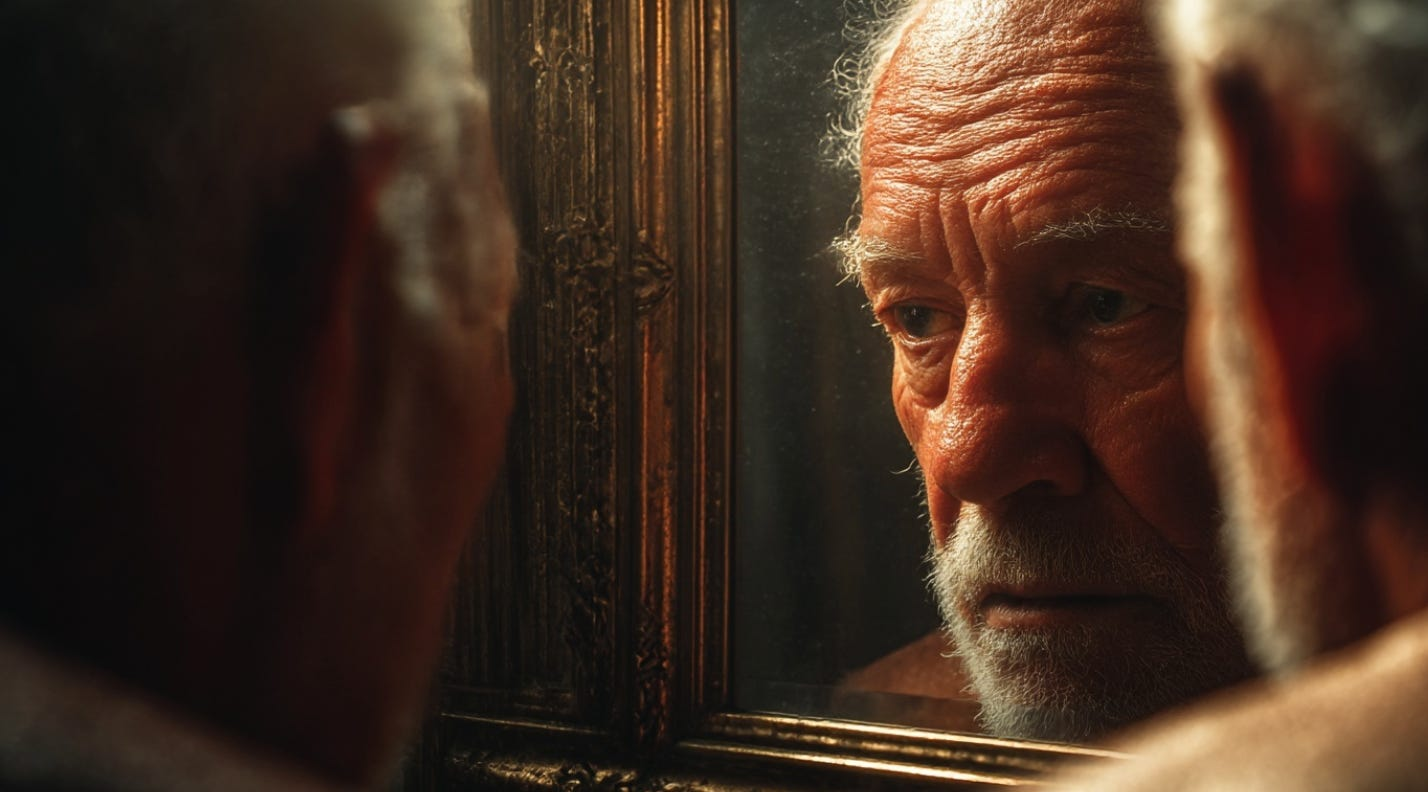
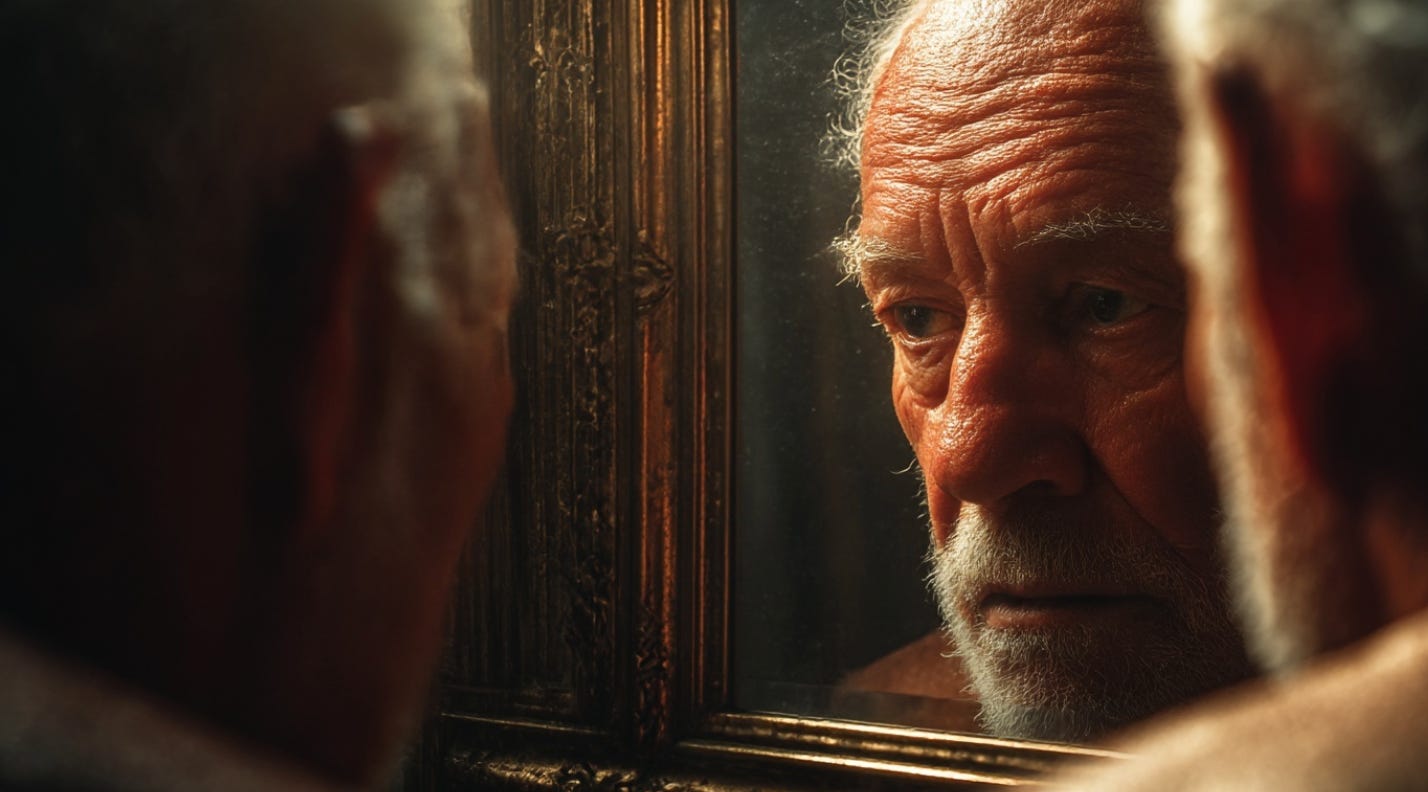
The shock always arrives on a nothing sort of evening.
You’re rinsing mugs, half-listening to the radio, waiting for the kettle to click. It’s dark outside now, which means the window has stopped being a view and turned into a mirror.
You look up — and flinch.
For a split second your brain swears your mother is standing at the sink. The jawline. The slight downturn of the mouth. The soft sag under the eyes where life keeps its ledgers. You can feel your body preparing to say, “Tea, Mum?” before it catches itself.
Then the image sharpens.
It isn’t her.
It’s you.
You lean closer. We all do. A small, private examination under poor lighting. You tug the skin as if your fingers were an editing app. You tilt your head left, then right, searching for the face you still carry internally — the one from whichever decade you privately believed you were most yourself.
Maybe it’s you at twenty-five, on a friend’s floor at three in the morning, certain the world is about to open. Maybe it’s thirty-eight, pushing a buggy with one hand and answering messages with the other, exhausted yet important.
Wherever that internal photograph is pinned, it definitely isn’t in this kitchen window with your mother’s cheekbones and your father’s tired eyes staring back.
Our culture prepares us badly for this moment.
On one side, the “ageing gracefully” brigade, waving creams like fire extinguishers. On the other, a chirpy chorus demanding you “embrace your lines,” as if you’ve failed some moral exam if you feel even a flicker of grief at the changes.
Between panic and performative acceptance sits the honestly bewildered person in the glass thinking, “When, exactly, did this happen?”
If you’re over fifty, you remember when your parents first looked like this. Your mother at the mirror, ancient at forty-eight. Your father’s neck starting to crease above his shirt collar. You assumed — with the exquisite arrogance of youth — that it happened to them, to “grown-ups,” to some other species entirely.
The real shock isn’t the lines.
It’s realising you have crossed the invisible border into the category you once dismissed. You are now — to someone — the person with old hands. The one whose stories begin with “I remember when…”
It would be so easy to turn the mirror into an adversary from here on. A daily guerrilla war of angles and denial. A tone you wouldn’t use on a friend, aimed squarely at yourself.
But pause. Look again.
Because the face startling you isn’t only yours.
It’s the sudden reappearance of the person who raised you — complete with every knot of history you shared.
And that’s where the real story begins, just below the paywall.
If this rang a little too true, the deeper part — the inheritance we fear and the choices still left — continues for paid readers below.