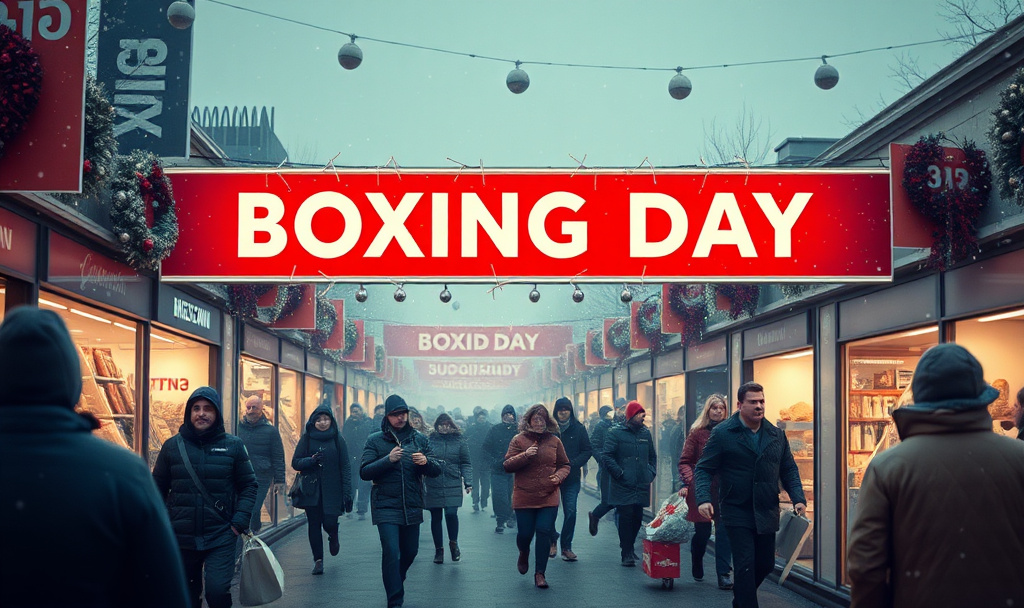
There are two types of people on Boxing Day.
The first type stays home.
They’re still digesting yesterday’s turkey. They’re wearing pyjamas that haven’t been washed since Tuesday. They’re watching films they’ve seen before while eating cheese that nobody asked for but everyone’s grateful exists.
They are wise. They are sensible.
They have made peace with the fact that Christmas is over and the rest of the week is just borrowed time.
Then there’s the second type.
These are the people who wake up on Boxing Day morning with a glint in their eye and violence in their heart.
These are the people who spent yesterday opening presents while secretly compiling a mental list of everything they actually wanted but didn’t get.
These are the people who have decided—with the kind of determination usually reserved for wartime commanders—that today is the day they will venture into the sales.
I was, for many years, the first type of person.
Then I married into the second type.
Now I know things.
Terrible things.
Let me tell you about Boxing Day shopping. Not the civilised online version where you click “buy now” while still in your dressing gown.
The real thing.
The full-contact combat sport that happens in shopping centres across Britain every 26th of December.
It begins with The Conversation.
“Should we go to the sales?”
This is not actually a question. It’s a declaration disguised as a question. The decision has already been made.
You’re going.
The only variable is whether you go willingly or whether you’re dragged there while making increasingly desperate excuses about needing to finish the leftover trifle.
By 8:30am, you’re in the car.
You suggested leaving after lunch. You were told, with the patience of someone explaining basic physics to a child, that “all the good stuff will be gone by then.” You pointed out that the shops don’t even open until 9am. You were given a look that suggested you fundamentally misunderstand how Boxing Day works.
You arrive at the shopping centre at 8:47am.
The car park is already full.
Not mostly full.
Completely full.
There are cars circling like sharks, waiting for someone—anyone—to leave. Someone’s abandoned their vehicle in a space that isn’t technically a space but rather a “creatively interpreted section of pavement.” You join the queue of cars that have given up on parking properly and are now just blocking other cars in the hope that this will somehow resolve itself.
It will not resolve itself.
By 9:15am, you’re inside.
The first thing you notice is the noise.
The content below was originally paywalled.
Not normal shopping centre noise. This is the sound of hundreds of people who have collectively decided that today is the day they will finally buy that thing they’ve been thinking about for six months, and they will do it before anyone else does.
The second thing you notice is that everyone is moving with purpose.
Not casual browsing purpose. Military operation purpose. They know where they’re going. They know what they want. And God help anyone who gets in their way.
The sales, you see, operate on a very simple principle: everything you didn’t know you needed yesterday is suddenly 50% off and absolutely essential today.
Did you need a new toaster? No. You have a toaster. It works fine. But this toaster is £30 off, and it has four slots instead of two, and suddenly you’re standing there with a boxed toaster under your arm trying to remember if you even ate toast this year.
Did you need new towels? Absolutely not. You have towels. You received towels for Christmas from someone who clearly thinks your towels aren’t good enough. But these towels are Egyptian cotton, and they’re half price, and before you know it you’re in a queue holding six towels while wondering what happened to your life.
This is how the sales work.
They prey on your weakness.
They exploit the part of your brain that thinks “it’s a bargain” is a legitimate reason to buy something you’ll use twice and then store in a cupboard for seven years.
The clothing section is a war zone.
There are no sizes left. Only XS and XXL, which is apparently the only sizing system British retail believes in. The changing rooms have a queue longer than the queue for the bar at a wedding. Someone’s having an argument with their partner about whether burgundy counts as “a normal colour for trousers.”
You find something you like. It’s the wrong size.
You find the right size. It’s the wrong colour.
You find the right size in the right colour. Someone else picks it up three seconds before you do.
You make eye contact.
There is a brief moment where you both consider what you’re willing to do for a 40% discount on a jumper you don’t strictly need.
They win. You move on.
By 11am, you’re carrying bags.
Not because you’ve bought things you needed. Because you’ve bought things that were on sale. There’s a difference, apparently, though you’re no longer sure what it is. You’ve bought a gadget for the kitchen that promises to “revolutionise meal prep” despite the fact you’ve been eating the same seven meals on rotation for the past decade.
You’ve bought socks. Not because you needed socks—you opened eight pairs yesterday—but because these socks were three pairs for £10 and that’s “basically free.”
You’ve bought something called a “multi-purpose organiser” that you will absolutely use to organise that drawer in the kitchen that’s full of batteries, rubber bands, and receipts from 2019.
You will not.
It will live in the garage with all the other multi-purpose organisers you’ve bought in previous sales.
By noon, you’re done.
Not because you’ve finished shopping. Because your soul has left your body. You’ve seen things. People fighting over half-price duvets. Someone returning a jumper they bought an hour ago because they found it cheaper in another shop. A child having a complete emotional breakdown in the toy section while their parents pretend not to notice.
You shuffle back to the car park carrying bags full of things you didn’t need yesterday and won’t use tomorrow. Your feet hurt. Your head hurts. Your bank account has taken damage that it won’t recover from until February.
But you got some bargains.
Or at least, that’s what you’ll tell yourself when you’re unpacking it all later and realising you bought a George Foreman grill despite not eating grilled food since 2003.
By 1pm, you’re home.
The bags are dumped in the hallway. Someone asks if you got anything good. You’re not entirely sure.
You’ve bought things, certainly.
Whether they qualify as “good” is a question for future you to answer when you’re trying to work out what to do with a novelty ice cube tray shaped like the Titanic.
You collapse on the sofa. The dog has eaten something it shouldn’t have. The telly is showing the same film from yesterday. Someone’s already suggesting you go back out tomorrow because “the sales get better as the week goes on.”
They do not get better. They get worse. But you’ll go anyway, because this is Britain, and we’re nothing if not committed to traditions we don’t fully understand.
So here’s to Boxing Day.
The day we collectively pretend that buying things we don’t need at reduced prices is somehow a victory.
The day retail workers question every life choice that led them to this moment.
The day the British public demonstrates that we’re still capable of organised chaos when properly motivated.
Merry Boxing Day.
May your purchases be useful and your receipts be findable when you inevitably need to return half of it next week.