AI-curious… or did I mishear “bi-curious”?
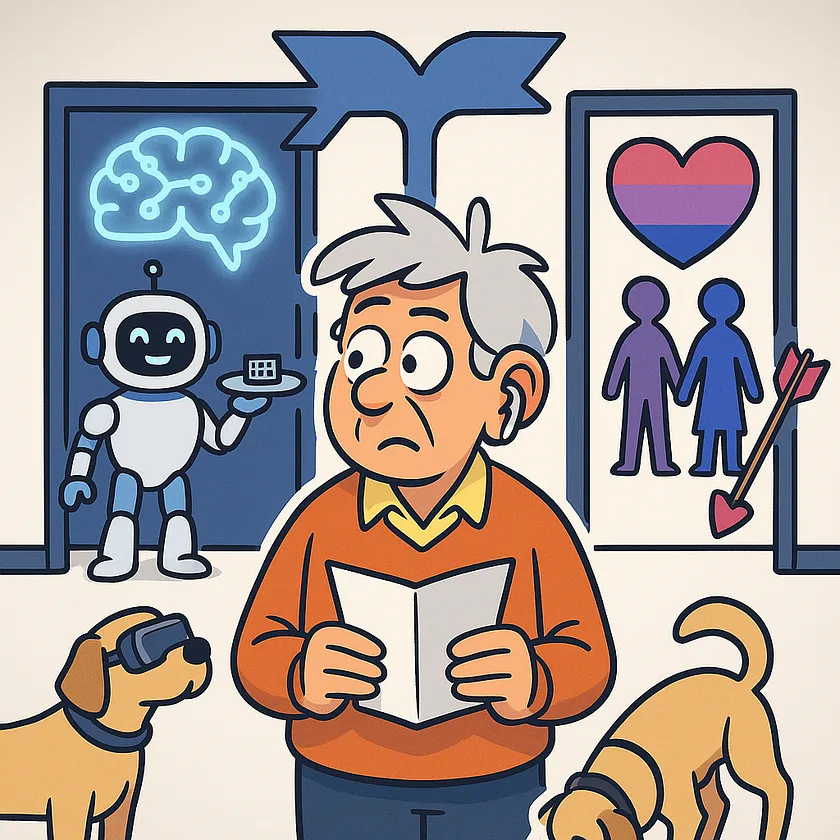
I swear someone at the garden centre said they were “bi-curious” about technology. Turned out they were “AI-curious,” which is entirely different and considerably less likely to get you disinvited from Sunday lunch. The point is: everyone’s curious about AI. We nod sagely about “the future” while quietly hoping it’ll make the printer stop behaving like a haunted Victorian child.
The national mood is this: we don’t know what AI is, what it wants, or why every company is suddenly “powered by it,” including, I’m told, a brand of hummus. We’ve seen futuristic demos where a robot butler books a flight, writes a novel, and folds the fitted bed sheet without swearing. Meanwhile we’re stood there, phone in hand, asking, “Could you, perhaps, just help me find the email I accidentally filed under ‘Important Horse’?”
Here’s the real scandal: AI isn’t complicated. It’s just a very keen assistant who never sleeps, never takes a tea break, and only gets stroppy if you ask it to invent a time machine or understand the offside rule. You tell it what you want, in normal human words, and it has a good crack at doing it. Sometimes it’s brilliant. Sometimes it’s like asking a Labrador to organise your filing cabinet: bags of enthusiasm, not always sure where to put the stapler.
So why are we all AI-curious? Because, deep down, we suspect there’s a button somewhere that turns modern life from “mild daily faff” to “civilised efficiency.” We don’t want flying cars. We want Tuesdays back. We want four hours of nonsense shrunk to twenty civilised minutes and a smug little list that says, “Done.”
Right. Practicalities. What is it actually for, beyond writing poems about your toaster?
A tiny starter kit for the sensibly curious
- Your words, tidier. Dictate a rambling message the length of War and Peace and ask AI to turn it into a polite email that sounds like you, not a minor royal’s press office.
- Summaries without the waffle. Paste a long article and get a crisp recap with the three things worth knowing and one line you can nick for the group chat.
- Planning without pain. “I’m visiting York on Saturday; give me a three-stop plan with coffee, one museum, one hidden alley, and an escape route if it rains.” Boom: itinerary.
- Shopping sense, not spreadsheets. “Compare three e-readers under £150 for eyes that get grumpy after dark.” You’ll get pros, cons, and the one to actually buy, minus the forum warfare.
- Household brain. Turn a recipe into a shopping list in grams; convert US nonsense to proper measurements; make a two-week rotating dinner plan that doesn’t repeat chicken until morale collapses.
- Idea sparring partner. Stuck naming your workshop, blog, or allotment newsletter? Ask for 20 options in your vibe (“plain-English, wry, not cringe”), then prune.
- Learning buddy. “Explain blockchain as if I’m a bright 12-year-old who thinks it’s a chain you use to block a toilet.” You’ll get metaphors that actually land.
None of this requires a PhD, a hoodie, or unbearable optimism. It requires the same skill you already use to boss around a tradesman: be specific, be reasonable, and don’t ask for a cathedral by Friday unless you’re happy with a shed.
A few guardrails from the School of Hard Knocks (Of AI):
- Say what “good” looks like. “Two paragraphs, UK English, light humour, no jargon.” It listens. Mostly.
- Give it a sample. Paste a paragraph you like and say, “Match this tone.” Miraculously, it stops sounding like a brochure for a mid-priced hatchback.
- Iterate like you mean it. First draft a bit meh? Say what’s wrong: “Snappier. Fewer adjectives. And no motivational quotes from a billionaire, thanks.”
- Keep your brain on. Treat AI like a capable intern: helpful, fast, occasionally weird. You’re the adult in the room.
If you want a proper hand-hold through this—real prompts, real examples, no Silicon Valley hand-waving—I share weekly mini-guides and cheat-sheets on togt, my corner of the internet for smart over-60s who like results without the faff. The tone is British, the advice is practical, and the jokes are, regrettably, mine.
The bigger picture? AI won’t replace you. It will replace the version of you that insists on doing everything the slow way out of principle. You can spend an afternoon comparing 47 nearly identical gadgets and end up buying the wrong one anyway, or you can have a sensible five-minute chat with a digital Labrador that’s been taught not to chase cars. Up to you.
So yes—be AI-curious. Prod it, poke it, make it earn its silicon biscuits. Start small: one message you don’t want to write, one plan you don’t want to make, one decision you don’t want to drown in. If it saves you an hour and a headache, that’s not science fiction. That’s Wednesday.
And if you’d like more of this—useful bits, cheeky prompts, and a running commentary on how to get modern life to behave—pop your email on the list below and I’ll send the good stuff straight to you.
If this was useful, there’s more like it on my Substack, The Old Grey Thinker — join here: https://substack.com/@theoldgreythinker