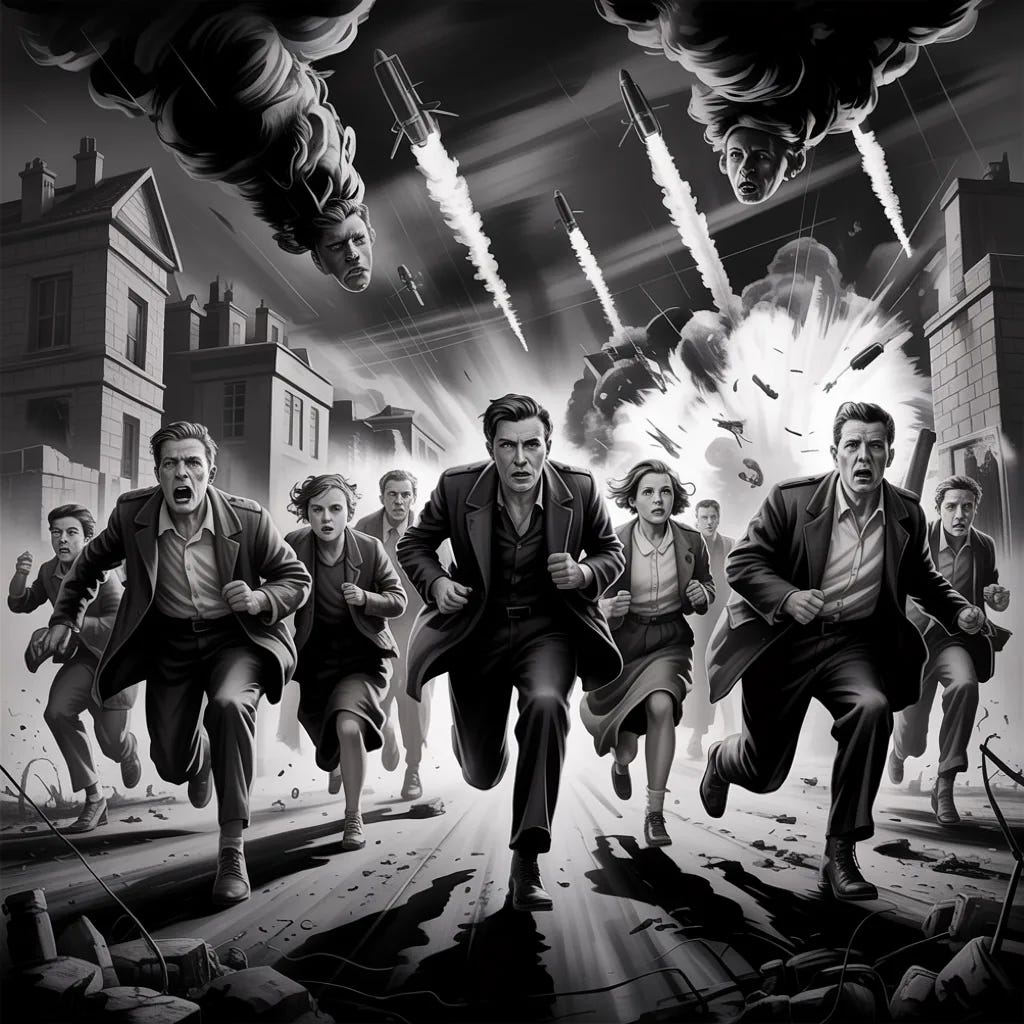
The kettle had just boiled when the notification came through.
Not a text from a friend. Not a weather update. A push alert telling me that the United States and Israel had launched strikes on Iran, that Tehran was burning, and that a supreme leader was dead. I read it standing next to the toaster, holding a teabag like it was a small, useless flag of surrender.
Then I made the tea anyway. Because what else do you do?
That was last Saturday. Since then, I’ve watched — from an armchair in the North East of England, with absolutely no influence over anything — as the Middle East caught fire, oil prices spiked, airports closed across the Gulf, a British RAF base in Cyprus took a drone strike, and NATO started intercepting missiles aimed at Turkey. I’ve watched all of this unfold on a phone screen roughly the same size as a digestive biscuit, in between doing the washing up and wondering whether the bins go out on Thursday or Friday.
The disconnect is surreal.
And strangely familiar.
The Shape of It
I’m not a foreign policy expert. I’m a retired ship’s captain with a Substack and a tea habit.
But I’ve been alive long enough to recognise the choreography.
I was a child during the Cuban Missile Crisis.
A teenager when Vietnam was still on the evening news.
I remember the Falklands, the slow horror of Yugoslavia, the Gulf wars — plural — and the twenty-year disaster of Afghanistan that ended with people clinging to aircraft.
I remember being told, each time, that it would be quick.
Surgical.
Contained.
Over by Christmas, or Ramadan, or whatever deadline sounded reassuring enough to keep the markets steady.
It never was.
And now I’m watching a new one unfold with the same vocabulary. “Targeted strikes.” “Proportional response.” “De-escalation through strength.” The phrases haven’t changed in forty years. They just rotate, like a greatest hits album nobody asked for.
The American president says it’ll last four weeks.
I’ve heard that before.
I heard it about Iraq.
I heard it about Afghanistan.
Four weeks is what you say when you’ve started something you don’t know how to finish, and you need the public to look the other way long enough to make stopping feel like someone else’s problem.
The Peace Dividend We Were Promised
Here’s what quietly enrages me.
My generation grew up inside the Cold War.
We did nuclear drills.
We watched the BBC and couldn’t sleep properly for a month.
We accepted, without anyone asking our permission, that a significant portion of national wealth would go toward weapons that existed solely to never be used. Mutually assured destruction wasn’t a policy — it was our childhood wallpaper.
Then the Berlin Wall came down, and we were told the grown-ups had won. There would be a peace dividend. Defence spending would fall. The money would go to hospitals and schools and pensions and all the infrastructure that had been quietly rotting while we pointed missiles at Moscow.
And for a while, it did. Defence spending dropped from over seven percent of GDP in the Cold War to barely two percent. The world exhaled. We were supposed to retire into that exhale — the generation that endured the anxiety so the next one wouldn’t have to.
Except now UK defence spending is racing back toward Cold War levels. The government’s committed to three and a half percent of GDP on the military by 2035, possibly five percent when you add in “security and resilience” — a phrase so elastic it could mean anything from submarines to surveillance cameras on your wheelie bin. The overseas aid budget has been gutted to pay for it. The Chancellor calls it “the biggest uplift in defence spending since the Cold War” like that’s a selling point and not an admission of catastrophic failure.
The peace dividend is dead. We just haven’t had the funeral yet.
The Kitchen Table Intelligence Agency
You know what’s strange about watching a war when you’re retired? You have time to actually pay attention.
When I was working, news was background noise — a headline between meetings, a bulletin in the car, a scroll before sleep. Now I’ve got hours. I read the analysis. I follow the threads. I cross-reference what the BBC says with what Al Jazeera reports and what the American outlets carefully omit. I’ve become a one-man intelligence agency operating from a kitchen table with a laptop, a teapot, and an increasingly cynical disposition.
And here’s the uncomfortable part: I’m probably better informed about this conflict than most people half my age who are too busy working to notice that the world is rearranging itself around them.
Not because I’m smarter.
Because I’m retired, and retirement gives you the one resource that changes everything: time to think.
But nobody asks retired people what they think about geopolitics.
We’re supposed to be doing crosswords and complaining about our knees.
The idea that someone who spent forty years navigating the actual world — literally, in my case, across oceans, through war zones, past piracy corridors — might have a useful perspective on global conflict apparently doesn’t occur to the twenty-eight-year-old podcast hosts explaining the situation to each other.
What You Notice When You’ve Seen This Before
Pattern recognition.
That’s what age gives you, and what youth can’t buy.
I notice that the language of war hasn’t evolved since I was young, but the technology has changed completely.
We’re watching drone swarms, hypersonic missiles, and cyber operations play out in real time on social media, narrated by people filming from their balconies. War used to happen somewhere else, reported by professionals who’d been trained not to flinch. Now it happens on your phone, between the group chat and the Wordle.
I notice that the people making the decisions are roughly my age, but they’re operating from a playbook written for a world that no longer exists — just like the retirement brochure I wrote about last October.
The assumption is the same: that twentieth-century frameworks still apply in the twenty-first century. They don’t. Not for pensions, and not for wars.
I notice that the markets panicked, oil surged, the Gulf airports shut, and within forty-eight hours people were already bored of it.
That’s the most terrifying pattern of all — not the escalation, but the normalisation. The speed at which “unprecedented” becomes “Tuesday.”
I notice that nobody is protesting.
Not like they did for Iraq. The streets are quiet. Whether that’s exhaustion, apathy, or the slow realisation that marching doesn’t change anything anymore, I genuinely don’t know. But the silence is louder than the bombs, if you’re old enough to remember when people used to shout.
The Bill Arrives at the Wrong Table
Defence spending doesn’t exist in isolation. It comes from somewhere.
The overseas aid budget — the one that funded clean water programmes, vaccination campaigns, and schools in countries that never asked to be part of anyone’s war — has been slashed to pay for missiles. The NHS is in permanent crisis. Local councils are functionally bankrupt. The state pension still doesn’t cover the basics for millions of people who did exactly what they were told: worked hard, paid in, retired quietly.
And now the bill for rearmament lands on the same kitchen table where I read the notification last Saturday. Not as a separate invoice. As a slow, grinding squeeze on every public service that actually keeps retired people alive. The government can apparently find billions for things that explode but can’t find the budget to heat a pensioner’s house or staff a GP surgery within driving distance.
I’m not a pacifist.
I spent decades in an industry where you understood that the world is dangerous and that force sometimes has a role.
But I’m old enough to know the difference between necessity and momentum — and this has the feel of momentum.
Things happening because the machinery of escalation is easier to start than to stop.
The Cold Tea Problem
Here’s where I land, and it isn’t comfortable.
I’m sixty-seven years old, sitting in a kitchen in Hartlepool, watching a war I can’t stop and didn’t start, with decades of experience that nobody’s asking for and a cup of tea that’s gone cold because I forgot about it while reading casualty figures on my phone.
I have pattern recognition but no power.
Perspective but no platform — well, apart from this one.
I know what the shape of escalation looks like because I’ve lived through enough of them to see the choreography before the final act.
And I know, with the weary certainty that comes from decades of watching promises break, that “four weeks” won’t be four weeks.
It never is.
The brochure said retirement would be peaceful. Golf, grandchildren, gentle irrelevance. It didn’t mention sitting in your kitchen watching the world rearm itself with money that used to go to keeping you alive, while the news cycle moves on to something else before the first war is even finished.
I don’t have a solution.
I’m not sure anyone does.
But I know this: the people with the most experience of what happens when the world goes wrong are currently the most ignored people in the conversation.
And that seems like exactly the kind of quiet, structural stupidity that got us here in the first place.
The kettle’s gone cold. I’ll boil it again. That much, at least, I can still do.