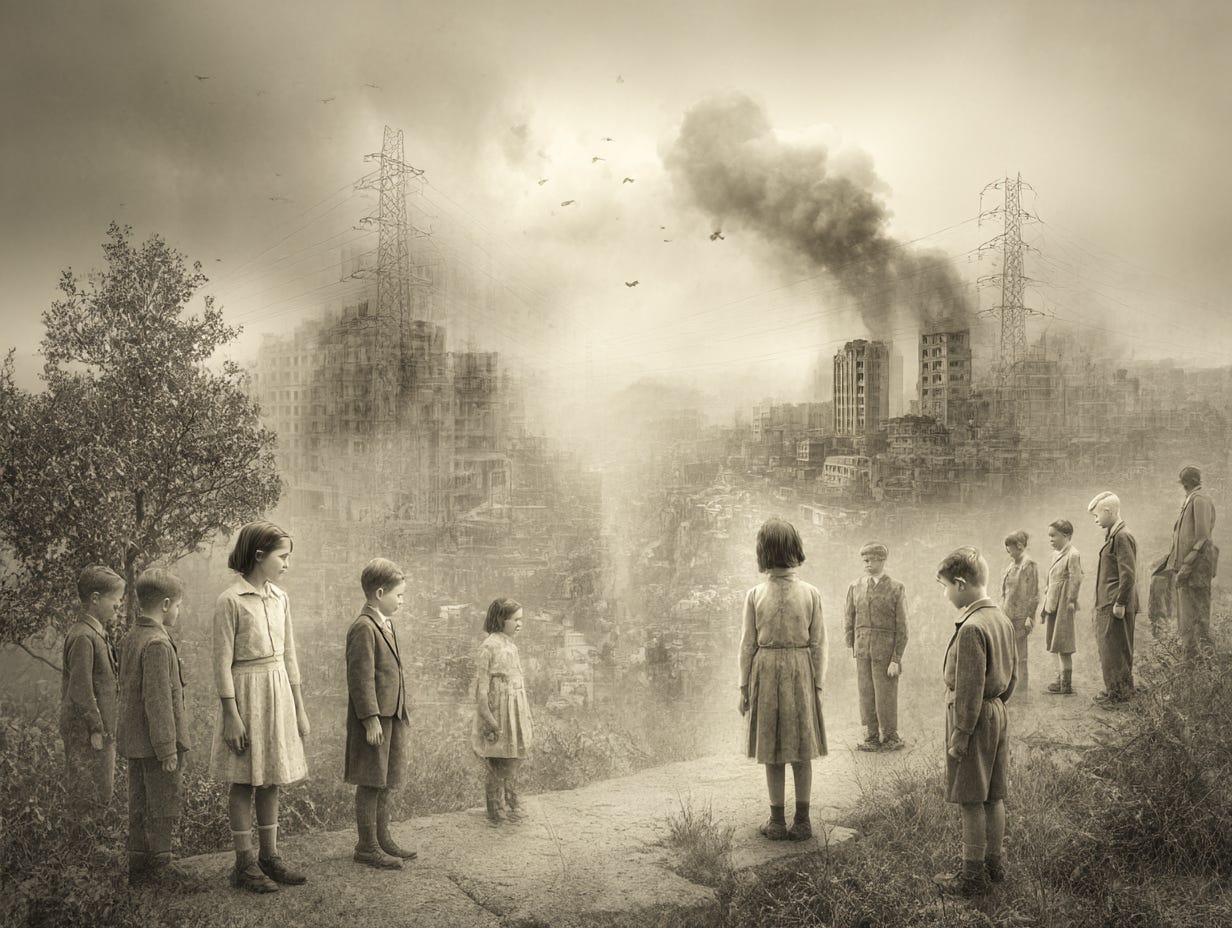
Last Tuesday, my granddaughter asked me to show her how to find something without using Google.
She’s sixteen. Bright as hell. Top of her class in everything that matters. But she genuinely didn’t understand the question.
“What do you mean, without Google?” she said, in the same tone you’d use if someone asked you to explain breathing without oxygen.
I tried describing card catalogues. Encyclopaedias. Actually asking librarians for help. Looking things up in phone books. She listened politely, the way you’d humour someone explaining how they used to hunt mammoths with sharpened sticks.
Then she said something that’s been rattling around my head ever since.
“So how did you know if something was true?”
That’s when it hit me. We’re the last generation that remembers what the world was like before. Before the internet. Before smartphones. Before everything became algorithmic, surveilled, and optimized for engagement metrics.
And that knowledge is about to become extinct.
Unless we document it. Now.
The Inconvenient Witnesses
Every conversation about technology assumes it’s progress.
Every discussion about AI assumes efficiency is the goal.
Every corporate meeting treats experience as a liability and youth as an asset.
But nobody’s asking the essential question: what are we losing?
I’ve spent forty years watching technology make certain things better and other things demonstrably worse. I’ve seen privacy disappear. I’ve watched conversation become performance. I’ve observed people become less capable of boredom, solitude, and the kind of deep attention that actually produces original thought.
And when I mention this, I get told I’m “resistant to change” or “nostalgic for a world that wasn’t actually better.”
But that’s not what I’m saying.
I’m saying: we’re the only witnesses to the before-and-after comparison, and nobody’s asking us what we saw.
A twenty-five-year-old developer designing social media has no frame of reference for what human connection looked like before it was mediated by screens and optimized for dopamine hits. They literally cannot see what’s been lost, because they never experienced it in the first place.
We can.
We’re the control group in the largest uncontrolled experiment in human history. And we’re being quietly shuffled off stage just when our perspective matters most.
The Numbers Nobody Mentions
This isn’t a small cohort having a moan about the old days.
This is a massive, unrepeatable historical moment.
By 2030, everyone born before 1980 will be over fifty.
READ THAT AGAIN
That’s the last generation that spent their formative years in an analog world. The last people who built careers without email, fell in love without dating apps, navigated cities without GPS, and learned things through sustained effort rather than instant search.
Within twenty years, most of us will be dead.
And with us dies the only living memory of what it was like to be human before the algorithm took over.
Think about what we know that nobody younger than forty-five can access firsthand:
How people made decisions without Googling every minor choice.
What face-to-face conversation felt like without phones sitting on the table like loaded weapons.
How communities actually formed without Facebook groups deciding who belongs.
What it took to learn something deeply instead of skimming Wikipedia and calling it research.
How people handled uncertainty before constant connectivity turned every unknown into an emergency.
What privacy meant when it was the default setting, not a luxury product.
This isn’t nostalgia. It’s anthropology.
We’re the indigenous people of the analog world, and our culture is about to disappear without anyone writing it down.
The Archive That Doesn’t Exist
Here’s the strange part: no institution is systematically recording this.
Universities study history. Tech companies study user behavior. Sociologists publish papers. But nobody’s documenting the cognitive and cultural shifts we’ve witnessed firsthand, in real time, over six decades.
Nobody’s asking: what changes when you stop memorizing phone numbers because your phone does it for you?
What’s lost when getting lost stops being normal and starts being a technological failure?
What happens to patience when waiting becomes an inconvenience to be eliminated rather than just… what you did?
What dies when wanting to know something stops requiring effort, and knowing becomes as frictionless as breathing?
The generation coming up thinks these questions are theoretical.
They’re not. We lived the experiment. We saw what changed. We remember what it cost.
And in twenty years, that memory will be gone. Unless we write it down.
What I’m Actually Doing
So here’s what I’ve started, and why I think it matters more than it sounds.
I’m documenting everything I remember about “before.”
Not as a complaint. Not as some tedious plea to return to typewriters and telegram. But as a record. Evidence. A baseline measurement from before the variables changed.
The small things that shaped how we think:
The patience required to wait a week for a letter and the discipline of making that letter count because you couldn’t just delete and start again.
The commitment of making plans without being able to change them via text five minutes beforehand.
The actual skill involved in finding information in a library instead of typing six words into a search box.
The experience of being genuinely unreachable and how that felt both terrifying and liberating in equal measure.
The weirdness of not knowing things and being completely comfortable with that state until you had a reason to find out.
Some of this will sound quaint. Some will sound like unnecessary hardship. But here’s why it matters now:
The next wave of technology is being designed by people who have no memory of a pre-digital world.
AI. Virtual reality. Brain-computer interfaces. All of it being built on assumptions that go back twenty years, maximum.
But we’ve got sixty, seventy, eighty years of perspective. We know what humans are capable of without constant technological mediation. We know what we’re giving up even when we’re gaining something else. We remember that every innovation comes with a trade-off, and we’re old enough to have watched those trade-offs compound over decades.
That knowledge has value.
Not as a brake on progress. Not as some Luddite manifesto. But as a reference point. A reminder. A baseline against which to measure what comes next.
The Responsibility Nobody Mentioned
If you’re reading this and you’re anywhere near my age, you’re sitting on something genuinely irreplaceable: memory of the before-times.
Your grandchildren will never know what it was like to be bored enough to stare out a car window for three hours and have that boredom gradually transform into something like meditation.
They’ll never experience the satisfaction of finding a book in a library after twenty minutes of searching through card catalogues and dusty shelves.
They’ll never feel what it’s like to say goodbye to someone and genuinely not know when you’ll speak again, and how that uncertainty made the connection more valuable, not less.
Unless you write it down.
Not as a memoir. Not as “the good old days.” But as data. As testimony. As evidence that humans once operated differently, and that difference shaped how we think, connect, and understand the world.
Start small if you want:
Write one post about something you remember that no longer exists.
Record a voice note describing how you used to do something mundane that’s now automated.
Have a conversation with someone younger and notice what you have to explain that they simply don’t have the context to understand.
Because in twenty years, when everyone under sixty has spent their entire conscious life inside algorithmic systems, your memory will be the only proof that humans were once different.
And that proof might be exactly what they need to build better technology.
Or at least to know what questions to ask.
What Happens Next
I’m not trying to stop progress. I’m trying to document what we’re leaving behind so the next generation can choose what to keep.
The brochure sold us retirement as the end. Turns out it might be the most important beginning — the moment we realize we’re carrying knowledge nobody else has, and we’ve got perhaps twenty years to pass it on before it disappears entirely.
Some of it will seem trivial. How we used to give directions. How we remembered things. How we stayed in touch.
But all of it matters. Because the generation designing our future has no idea what humans were like before screens became mandatory equipment for existing in the world.
We do.
And that makes us more than just old. It makes us essential.
You can help. Or you can let the memory fade into the same cultural amnesia that’s already erased most of what came before.
I know which one I’m choosing.
The question is: what are you going to write down while you still remember?