The Last Letter Writer
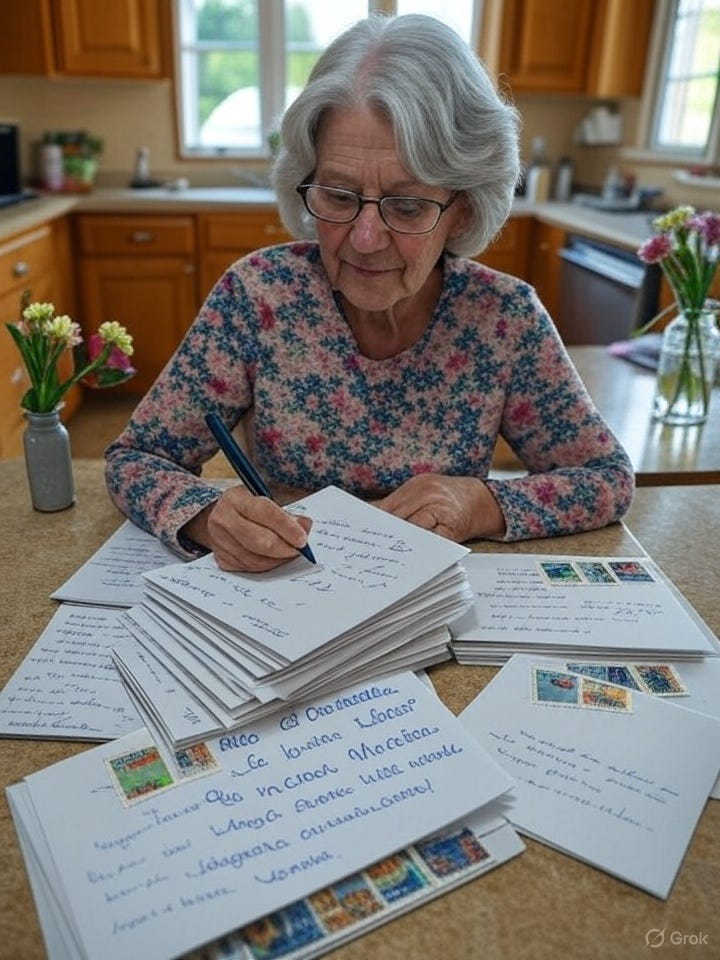
On her kitchen table sits a stack of envelopes, each addressed in looping blue ink. Stamps from every continent decorate the corners: tiny artworks on cream-coloured paper. This is Margaret’s daily ritual. At seventy-two, she may be one of the last people who still writes letters to friends around the world by hand.
It started when she was a teenager in Sunderland. A school exchange trip to Denmark introduced her to pen pals, and she never stopped. Half a century later, her circle of correspondents stretches from Buenos Aires to Bangalore. Some she has never met, yet she knows the names of their grandchildren, the colour of their front doors, the weather patterns of their coastlines.
There’s something about Margaret’s letters that email cannot imitate. Her friends say it is not just the words, but the way the paper carries her presence. The way her ‘R’ leans slightly forward as if hurrying, the way the ink sometimes blots when she pauses to think. These marks are more than quirks: they’re traces of her humanity.
One of her friends in Canada told me she reads Margaret’s letters twice — once to hear the story, and again to notice the details. “It’s like sitting with her across the table,” she said. Another, in Japan, keeps them bound with ribbon and re-reads them during New Year, a ritual of reflection and continuity.
Why does this matter, in an age when we can send a message across the world in less than a second? Because the very slowness is the gift. A handwritten letter is proof of patience, attention, and presence. To write one, you must stop, choose words carefully, and dedicate time to someone who matters. The weight of the envelope reminds the receiver: I was worth this effort.
Margaret insists she is no romantic. “I just enjoy it,” she says, shrugging. Yet she admits she chooses her paper with care. Pale ivory for serious news. Pastel blue when she wants to be playful. Her favourite is a thick cream stock that carries the scratch of her fountain pen like a violin string.
Her letters are not long. Two or three pages, written after breakfast with her tea, often describing the ordinary: the neighbour’s cat, the roses in her garden, a memory stirred by a song on the radio. Yet these details are what her friends treasure. In their own hurried lives, Margaret’s letters arrive like postcards from a slower, saner world.
The world may not need more content, but it could use more connection. Margaret, the last letter writer, shows us that sometimes the old ways are not outdated — they’re timeless.
Perhaps tonight you could pick up a pen, write a few lines, and send them to someone who hasn’t heard from you in years. Don’t type. Don’t text. Just write. You might be surprised at how much it means.
If this piece spoke to you, you might enjoy my newsletter, The Old Grey Thinker. It’s where I share more reflections on life, learning, and a touch of humour for those of us navigating the later chapters. You can join here: