(and why we’re sick to death of pretending it’s connection)
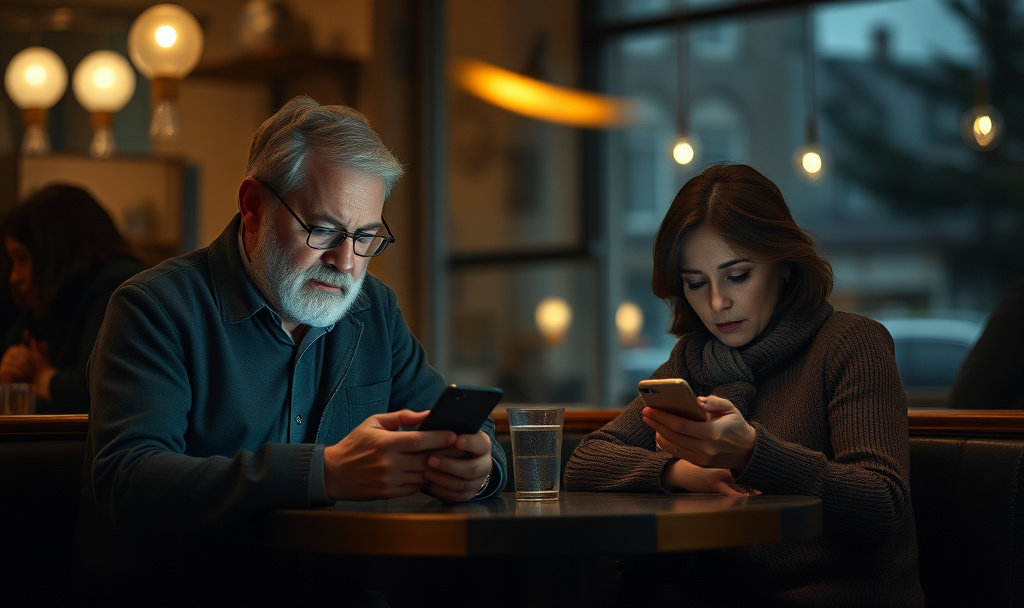
Last week I met an old friend for lunch.
We hadn’t seen each other in months.
Within five minutes, we were both looking down — scrolling, half-listening, liking other people’s lives while ignoring our own.
We laughed about it, but it stayed with me all day.
Somewhere between the pings and the posts, we forgot how to be present.
I don’t know about you, but I’m tired.
Not from age — from noise.
The kind that fills every silence until thinking feels suspicious.
The kind that replaces attention with reaction.
Every scroll, every “quick check,” another withdrawal from the account of calm we didn’t know we were depleting.
We’ve built the loudest world in history — and called it connection.
But here’s the truth that hit me over that coffee: noise is the new loneliness.
It tricks you into feeling surrounded while keeping you completely alone.
A decade ago, we thought constant communication would make us closer.
Instead, it made us chronically half-present.
Every conversation interrupted by a vibration.
Every opinion public before it’s thought through.
We used to say “I’ll think about it.”
Now we say “I’ll post about it.”
Connection has been replaced by performance — and we’re exhausted by the act.
Social media told us to “find our voice.”
But what it really meant was “never stop talking.”
The result?
Keep reading — and get more
This is where the full monthly Niche Box lives. Subscribe for $5/month (or $50/year) to get:
• Monthly Niche Box (usually worth $20)
• Full archive of essays
• Early access to new pieces
Or go deeper: Pay $80/year, get everything I’ve ever published (Foundation Member) Most readers choose the monthly plan and upgrade later. Start there.
A planet of people shouting past each other while the signal disappears beneath the static.
The algorithm rewards outrage, not understanding.
Clicks, not clarity.
And if you dare to pause, you vanish — the same way we older folk did when we stopped playing by youth culture’s rules.
Invisibility, it turns out, isn’t just about ageing anymore.
It’s what happens to anyone who goes quiet in a noisy room.
Most nights I catch myself reaching for my phone before my thoughts have even formed — as if silence might disappear if I don’t fill it fast enough. That’s when I realised the noise wasn’t coming from out there.
It was coming from me.
That’s the addiction no one talks about: the fear that if we stop contributing to the noise, we’ll stop existing inside it.
The irony is exquisite. We have more ways to speak than ever — and fewer things worth saying. I used to think I’d fallen behind.
Now I realise I’m just allergic to nonsense.
Because deep down, we all know it: this endless noise isn’t connection.
It’s a coping mechanism.
It fills the void where meaning used to live.
We scroll not to learn, but to numb.
We post not to express, but to prove we still exist.
And it’s driving us quietly insane.
The younger generations feel it too — they just don’t have the words yet.
You can see it in their eyes, in the way they hold their phones like oxygen tanks.
They’re not addicted to technology.
They’re addicted to attention.
And attention is the new currency — mined, traded, and sold back to us as identity.
But here’s the catch: you can’t outsource meaning.
You can only drown it.
We’re sick of being told to “build a brand.”
We’re tired of pretending self-promotion is self-worth.
We’re done with the dopamine economy that rewards outrage over insight.
The truth is, most of us don’t want to go viral.
We want to be understood.
But understanding takes time — and time is the one thing the modern internet refuses to give.
Here’s the quiet revolution:
Silence isn’t weakness.
It’s resistance.
Choosing to log off, think longer, or speak less isn’t falling behind.
It’s opting out of the performance economy.
The next wave of influence won’t come from people who shout louder.
It’ll come from those who build slowly, think deeply, and post when it matters.
I know this because I’ve seen it before.
When the internet first arrived, it was messy, hopeful, human.
People shared ideas, not identities.
Then came the noise — the metrics, the gamification, the rise of the personal brand.
But what’s happening now feels familiar: a quiet counter-culture forming in the margins.
Writers, builders, and thinkers choosing substance over spectacle.
Older voices returning, not as relics, but as anchors.

We don’t need to disappear to escape the noise.
We just need to tune differently.
Read long things.
Write short truths.
Talk to actual humans again.
Curate your inputs like you would your diet — less sugar, more sustenance.
We’ve spent a decade feeding the algorithm.
Maybe it’s time we fed our attention instead.
Silence isn’t absence. It’s a kind of presence.
The kind that makes space for curiosity to breathe again.
The kind that turns attention inward instead of scattering it outward.
Maybe that’s the real cure — not disconnection, but discernment.
Because the most radical thing you can do in an age of constant noise
is to stay quiet long enough
to hear yourself think.
If this resonated, you’ll probably like my first piece, The Invisibility Epidemic — about what happens when we fade from view.
This one’s about what happens when we’re seen too much, for all the wrong reasons.
Both are part of the same rebellion:
refusing to let algorithms decide who we are.
If this spoke to you, share it — or join The Old Grey Thinker my weekly letter for people who refuse to rust.
And if you’re ready to build your next act, start with Guides for Smart Seniors— because invisibility doesn’t pay the bills, and it doesn’t suit you.