Bonus post — This was gnawing at me, so here we are.
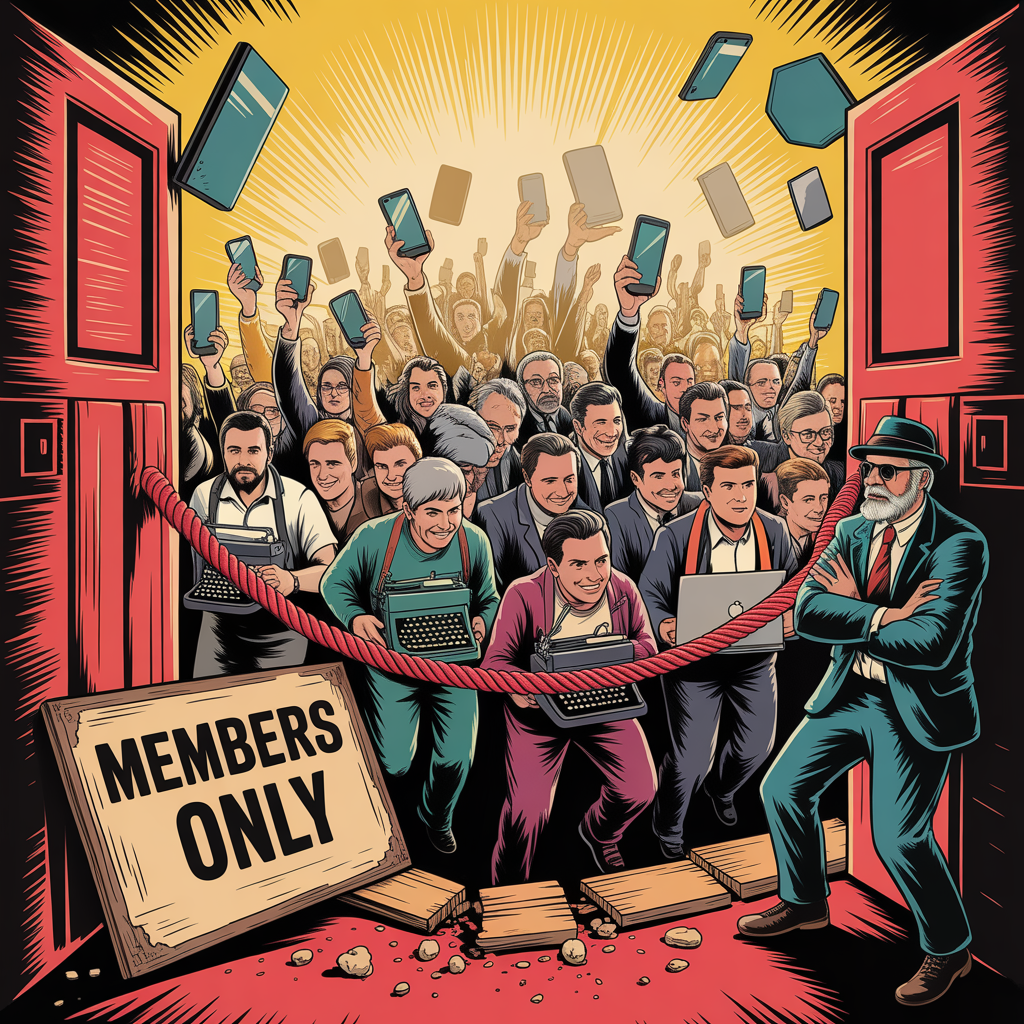
Here’s what’s really happening:
A bunch of people have drawn a moral line between “real writing” and “AI writing” — and they’ve drawn it in exactly the wrong place.
And I’m not going to say this nicely. Because this kind of gatekeeping isn’t protecting literature. It’s protecting ego. And if we keep pretending it’s a philosophical stance instead of fear, we’ll lose something that actually matters.
What “Real Writers” Actually Mean
When people say real writing, what they really mean is suffering.
They mean the midnight typewriter. The unpaid years. The visible struggle that supposedly earns you the right to call yourself a writer.
Which is, frankly, nonsense.
Writing — real writing — is communication. It’s the act of taking a thought in your head and landing it in someone else’s, cleanly and memorably. That’s the job. Whether you used a fountain pen, dictation software, Grammarly, or an LLM doesn’t matter.
What actually bothers the “real writers” crowd isn’t ethics. It’s that the barrier to entry just dropped through the floor. Anyone can now sit down and produce something readable in an afternoon — and that terrifies those who built their identity on how hard it used to be.
The People Who Actually Know What They’re Talking About
Here’s what should end this argument: the institutions that exist to protect writers have already accepted AI as part of the craft.
Take the Authors Guild — the largest writers’ organisation in the U.S., founded to defend authors’ rights against publishers and Big Tech. In 2024 they published AI Best Practices for Authors, a guide that explicitly acknowledges writers using AI for research, outlining, brainstorming, and character work. They don’t condemn it. They call it “normal, standard, professional practice.”
Their message is clear:
“Use AI as a tool — a paintbrush for writing.”
(Authors Guild, AI Best Practices for Authors, 2024)
Meanwhile, the Association of Writers & Writing Programs (AWP) — the centre of U.S. literary academia — hosted a 2025 panel titled “Writing & Publishing in the AI Era.”
Not “Why AI Is Killing Literature.”
Not “The Fraud of AI-Generated Content.”
They gathered to discuss how the craft evolves, not whether it survives.
Across the Atlantic, the Writers’ Guild of Great Britain (WGGB) issued its 2024 paper Writers and AI, which recognises both the risks and the opportunities. It argues that AI can help writers develop ideas and manage workloads — provided it’s used responsibly and writers retain creative intent.
None of these organisations are fringe. They are the gatekeepers — and they’ve already moved on.
So when people on Twitter scream about “authenticity,” they’re not defending literature. They’re defending status.
The Hypocrites Are Everywhere
Here’s the irony: the loudest complainers already use AI every day.
Spell Check. Grammarly. Autocorrect. Google. Voice-to-text. Editing software.
All artificial intelligence.
They just don’t see it.
One author recently pointed out that Spell Check is “a crude form of AI.” He’s right — and I guarantee that the same people railing against “AI writing” used it this morning.
The only difference is visibility.
When AI quietly fixes your grammar, it feels legitimate.
When it openly helps you brainstorm, it feels like cheating.
But that discomfort says more about identity than ethics. It’s not about how the work was made. It’s about being seen to suffer for it.
The Real Question Nobody Wants to Answer
If the tool doesn’t matter — only the words do — then how could you even tell?
You read a paragraph. It lands. It moves you. You don’t know if it came from a typewriter, a laptop, or a dictation app. And you shouldn’t have to.
So this debate isn’t about quality.
It’s about visibility of method.
They want the pain on display. They need to see the effort to believe it’s real.
That’s not defending literature.
That’s defending a mythology.
What’s Really Going On
This panic isn’t about writing. It’s about control.
For a hundred years, being a “real writer” meant access — to education, editors, and institutions. It meant gatekeepers deciding whose suffering was valid.
Now that the tools have levelled the field, anyone can produce publishable prose. The moat has drained.
That doesn’t threaten writing. It threatens hierarchy.
Because if writing isn’t about the suffering anymore, what does “real writer” even mean?
They don’t want to answer that. They just want the old barriers back.
But those barriers aren’t coming back.
The Real Conversation We Should Be Having
So if the Guilds, the universities, and the published authors have already accepted AI as part of the craft, why are we still arguing about whether it’s “real writing”?
The question isn’t if AI belongs in writing. That’s settled.
The real questions are:
— What happens to craft when writing becomes too easy?
— How do we keep voice alive when assistance is everywhere?
— What gets lost when struggle is optional?
— And do readers even care, as long as the words work?
These are the hard questions — and they won’t be answered on social media.
They’ll be answered by the work itself.
By writing that’s so good, so true, it doesn’t matter how it was made.
And that’s worth reading.
P.S. — What do you think?
Is it the gatekeeping that bothers you? The fear of change? Or are you one of the writers quietly using AI already while everyone else argues about it?
Either way, let’s talk. Because pretending this doesn’t matter is the only truly false note left in the conversation.