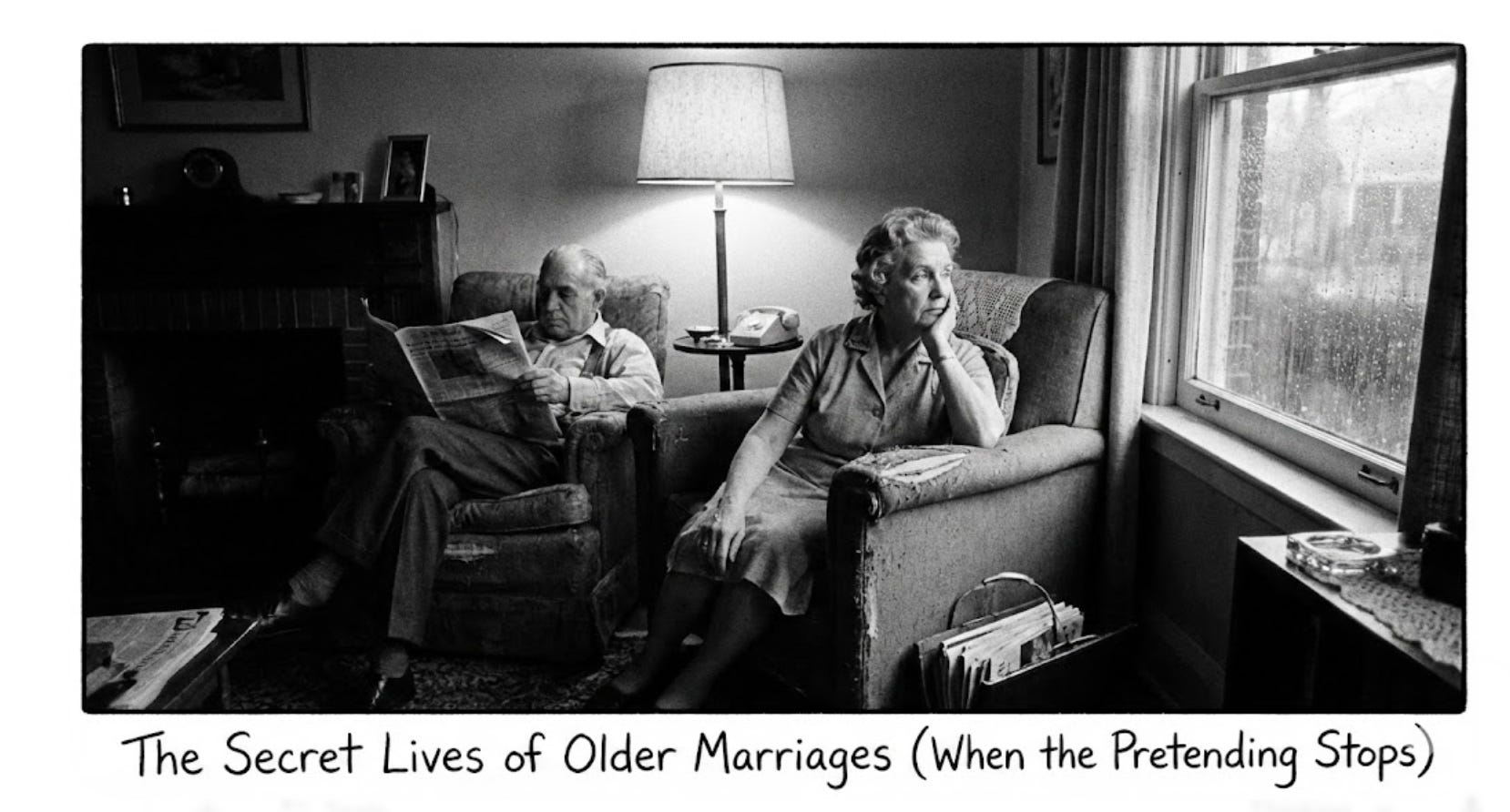
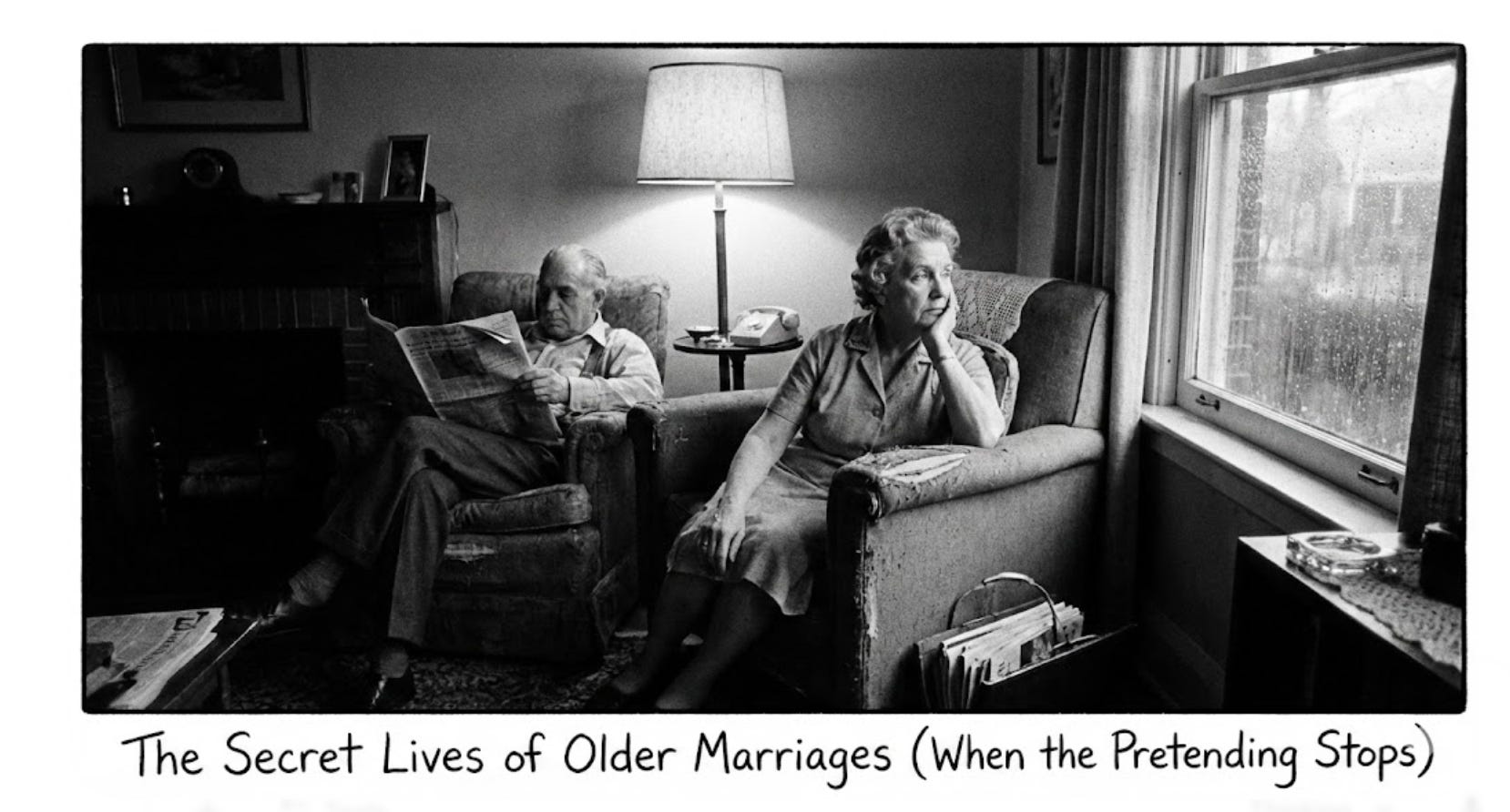
From the outside, long marriages look solid.
Golden anniversaries.
Shared grandchildren.
Two names on the card.
People say things like:
“You’re so lucky.”
“You must know each other inside out by now.”
“Relationship goals.”
Smile for the photo.
Cut the cake.
The truth, behind a million net curtains, is more complicated.
Plenty of older marriages are less a fairy tale… and more a set of secret treaties.
Some tender.
Some lonely.
Some quietly heroic.
What happens when the pretending finally stops?
The act you both agreed to
Most couples – if they make it past the first storms – end up with an unspoken deal:
These are the subjects we joke about.
These are the subjects we never touch.
This is how we do money/sex/family/holidays.
You build a life around those rules.
Children cement them.
Work cements them further.
Who had the time or energy to stop mid‑chaos and say, “Excuse me, I’m not sure this is emotionally sustainable”?
So you both get good at the act.
You know which version of yourself keeps the peace.
You know which version of them will walk out of the room.
Decades pass.
Then:
the kids move out
the career ends
the diary clears
And suddenly you’re sat across from each other at the breakfast table with more silence than subjects.
The act no longer fits, but you’re not sure what else to wear.
The three secret stories inside one marriage
Every long marriage, I’ve come to think, holds at least three stories:
The public story.
What friends and family think your relationship is like.
The shared story.
What you and your partner tell yourselves about “us”.
The private story.
What each of you carries alone about how it really feels.
If those three are roughly aligned, you get something like peace.
If they’re wildly different, you get a life that looks fine from the outside but feels hollow in the middle.
In retirement, when there are fewer distractions, the gap between those stories becomes harder to ignore.
You notice:
how often you swallow a comment
how rarely you laugh together now
how much of your “together time” is actually parallel scrolling
This isn’t about blame.
It’s about noticing which parts of your marriage are alive… and which are running on habit.
When the pretending stops (or tries to)
There are usually three triggers that stop the act:
A health scare.
Suddenly the future isn’t endless. Things you’ve tolerated for years feel unbearable.
A big change in roles.
Retirement, caring responsibilities, one partner becoming ill or less mobile.
A quiet, accumulated sadness.
Nothing dramatic. Just the slow realisation that life is shorter than the list of things left unsaid.
You may find yourself thinking:
“Is this really it?”
“We’ve spent a lifetime together and we don’t actually talk.”
“If I’d met them now, would we choose each other? Would they choose me?”
Those thoughts are frightening.
So we often do one of two things:
slam the lid back down and double‑down on the act
or blow everything up in the name of “finding ourselves”
There is a third option, less glamorous but more hopeful.
You can stay – if it’s safe – and start telling more truth.
Not all at once.
One brave inch at a time.
Little truths that change the atmosphere
The secret lives of older marriages rarely shift because of big speeches.
They shift because someone dares to say something small but real.
Instead of:
“Nothing’s wrong. I’m fine.”
You say:
“I feel lonely even when we’re in the same room. I’d like us to change that, if we can.”
Instead of:
“You never listen.”
You say:
“When you look at your phone while I’m talking, I feel unimportant. I’d like one meal a day where we put our phones away.”
Instead of:
“It’s too late for us.”
You say:
“We’ve fallen into habits that don’t suit us any more. Would you be willing to try something different for a month and see how it feels?”
You are not criticising their character.
You’re inviting them into a new shared story.
They may:
shrug
get defensive
laugh it off
Or they may surprise you.
Many older partners are far more scared than we are to rock the boat.
They’ve also noticed the distance.
They just didn’t know how to name it without feeling like a failure.
The quiet rebellions that bring marriages back to life
Here are a few rebellions I’ve seen – in my own life and in others’ – that make a difference.
None involve yoga retreats or re‑writing your wedding vows on a beach.
1. One honest check‑in a week.
A short conversation that isn’t about logistics.
Questions like:
“How are you really feeling about this stage of life?”
“What are you looking forward to this week?”
“Is there anything you’d like more or less of, between us?”
2. One small shared project.
Not a kitchen refurb.
Something like:
a regular walk and café on Tuesdays
planning a modest trip together
doing a puzzle instead of watching separate screens
Shared forward motion gives you something to talk about besides ailments and the news.
3. One protected area of difference.
Admitting:
“We don’t have to like all the same things. You can have your club, I can have my class. We meet in the middle.”
Can be oddly freeing.
When staying would mean staying small
Of course, some marriages are not just tired.
They’re unsafe.
Or suffocating.
Or built on patterns of contempt that no amount of “better communication” will fix.
In those cases, the bravest move may be to leave – practically, emotionally, or both.
But even then, the work is the same:
stop pretending
start telling yourself the truth about how it really feels
Older divorces often shock people because they assume:
“If it was bad, they’d have left years ago.”
They underestimate how much pretending two people can do to keep a life intact, especially when there are children, money, and social expectations involved.
If you do decide to go, after decades, it doesn’t mean the years were all a lie.
It means the story that suited you both then no longer fits the person you are now.
That’s grief.
It may also be the first honest thing you’ve done for yourself in a long time.
The secret that’s worth sharing
The secret lives of older marriages aren’t all sad.
Some are quietly beautiful.
I’ve seen couples who:
sit in companionable silence, both reading, feet touching
still make each other tea without being asked
have learned, after years of bumps, to say “I’m sorry” quickly and mean it
What they have in common is not perfection.
It’s truth.
They’ve stopped pretending to be the couple in the wedding photos.
They allow each other to be changed by time, by illness, by joy, by loss.
They’ve updated the story of “us” more than once.
And on the days when one of them feels like a stranger, they’re willing to turn towards each other and say,
“I don’t quite know who we are now. But I’d rather find out together than guess alone.”
That, to me, is the real romance of later‑life relationships.
Not grand gestures.
Not diamond anniversaries.
Just two imperfect humans, still daring – after everything – to be seen as they really are.
And to keep choosing, in small, daily ways, to stay present in the same story.
Even if they have to rewrite it.
Before you continue, a gentle note: paid subscribers get access to all of my private guides, behind-the-scenes AI methods, and step-by-step ways to turn your knowledge into income in a calm, grounded, sustainable way.
If subscribing isn’t right for you at the moment, you can always support my work by buying me a pot of tea.
I appreciate every kindness — truly.
⬇️ Keep reading for the deeper story — and the shift that changed everything.small kindness hit you harder than it should — this is the part you shouldn’t miss.
Or if you need to you can read the full story free here